
Create Natural Volume with your own Tissue
Fat grafting — also referred to as fat transfer, autologous fat transfer — is a cosmetic procedure where your own fat is carefully harvested from one part of your body and strategically placed in areas that lack volume or definition. This technique enhances contours and restores youthful fullness with natural-feeling results and long-lasting outcomes.
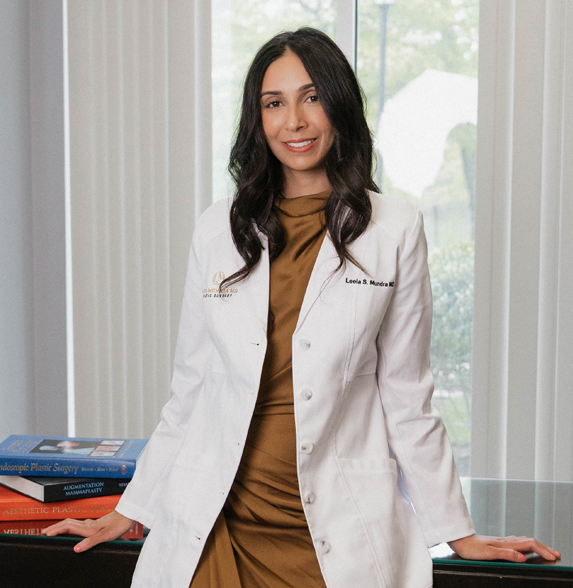
I am Dr. Leela, a Harvard Trained Plastic Surgeon, and I employ advanced fat grafting techniques to achieve refined, natural outcomes customized to your specific anatomy. Whether performed as a standalone treatment or in conjunction with another procedure, fat transfer can beautifully restore volume precisely where it is most needed.

What Is Fat Grafting?
Fat grafting uses your body’s own fat cells to replenish lost volume in the face and body. Fat is typically harvested using gentle liposuction from areas like the abdomen, thighs, or flanks, then purified and precisely reinjected into treatment areas such as:
- Face (cheeks, tear troughs, temples)
- Breasts (for natural breast augmentation or contour refinement)
- Buttocks (for natural enhancement)
- Lips and other localized areas needing volume
Because the fat is your own tissue (autologous), there is limited risk of allergic reaction to foreign substances.
Who Is a Good Candidate?
You may be an ideal candidate for fat grafting if you:
- Wish to restore volume to areas that have thinned with age or weight loss.
- Have sufficient fat in a donor area to allow for harvest.
- Want a natural, long-lasting alternative to synthetic fillers.
- Are in good general health and maintain a stable body weight.
- Desire enhancements that look and feel natural.
During your consultation, Dr. Leela will carefully assess your anatomy, aesthetic goals, and whether fat grafting alone or in combination with other procedures would best serve your needs.
Benefits of Fat Grafting
Fat grafting offers several advantages over traditional fillers or implants:
- Natural results using your own tissue.
- Long-lasting or permanent enhancement once the transferred fat establishes a blood supply.
- Dual benefit of contouring the donor site while enhancing another area.
- Versatility — can be used on face or body.
Reduced risk of allergic reaction compared with synthetic products.
About the Procedure
Fat grafting is performed in three main steps:
- Harvesting: Fat is removed via gentle liposuction from donor sites such as the abdomen, flanks, or thighs.
- Purification: Extracted fat is processed to remove fluid and impurities, leaving high-quality fat cells ready for transfer.
- Transfer: Fat cells are carefully injected into targeted areas with precision to optimize contour and volume.
Recovery and What to Expect
Recovery varies depending on the extent and location of the fat grafting:
- Mild swelling and bruising at donor and graft sites are common and typically improve within 1–2 weeks.
- Many patients return to normal activities within several days, though strenuous exercise should be avoided initially.
- Final results continue improving over weeks as swelling subsides and grafted fat stabilizes.
Because some fat may be naturally reabsorbed, a portion of the fat may persist long-term, creating enduring enhancement
Fat Grafting for the Body FAQs
What areas of the body can be enhanced with fat grafting?
Fat grafting is commonly used to enhance and refine:
- Breasts (natural augmentation or implant contour refinement)
- Buttocks (natural enhancement)
- Hips (hip dips correction)
- Areas with contour irregularities after liposuction
Because the procedure uses your own fat, it creates soft, natural-looking volume that integrates with your existing tissue.
Where does the fat come from?
Fat is typically harvested from areas with excess volume, such as:
- Abdomen
- Flanks (love handles)
- Lower back
- Thighs
The donor area is carefully contoured using liposuction, then the fat is purified and strategically injected into the enhancement area.
How much of the transferred fat survives?
Not all transferred fat will survive. On average, 60–80% of the fat establishes a blood supply and remains long-term.
For this reason, slight overcorrection is often performed during surgery to account for natural reabsorption.
Is fat grafting permanent?
The fat that survives the initial healing period becomes living tissue in its new location and is considered long-lasting.
Maintaining a stable weight helps preserve your outcome.
How long is recovery for body fat grafting?
Recovery depends on the treatment areas, but most patients can expect:
- Swelling and bruising in both donor and graft sites
- Compression garments for donor areas
- Limited pressure on the grafted area (especially with buttock transfer)
- Return to light activity within 1–2 weeks
Dr. Leela provides detailed post-operative instructions to optimize fat survival and healing.
Can fat grafting correct contour irregularities from previous liposuction?
Yes. Fat grafting is an excellent tool for smoothing dents, hollows, or uneven areas following prior liposuction or surgery. It allows precise contour refinement and softens transitions between areas.
Am I a good candidate for body fat grafting?
You may be a good candidate if you:
- Desire natural enhancement without implants
- Have sufficient donor fat
- Are at a stable, healthy weight
- Have realistic expectations about achievable volume
A consultation allows us to evaluate your anatomy and determine the safest and most effective approach for your goals.
Request a Consultation
Fields marked (*) are required