
Upper Eyelid Surgery and Brow Lift (2026): Complete Guide

TL;DR
Upper eyelid surgery (blepharoplasty) removes excess skin from the eyelids, while a brow lift raises drooping eyebrows to restore a youthful upper face. Many patients think they only need eyelid surgery when the real problem is brow descent, or both. When combined, upper eyelid surgery and brow lift produce better results than either procedure alone, with a single recovery period and lower total cost.
If you’ve noticed heaviness around your eyes, a tired expression that doesn’t match how you feel, or skin folding over your eyelid crease, you’ve probably started researching your options. The challenge is that “upper eyelid surgery and brow lift” covers two distinct procedures that address two different anatomical problems, and most people can’t tell which one they actually need.
This guide breaks down what each procedure is, the key terms you’ll encounter during your research, and the clinical reasoning behind combining them. The goal is to help you walk into a consultation already understanding the basics.
Explore brow lift surgery options to learn more about what this procedure involves.
What Is Upper Eyelid Surgery (Upper Blepharoplasty)?
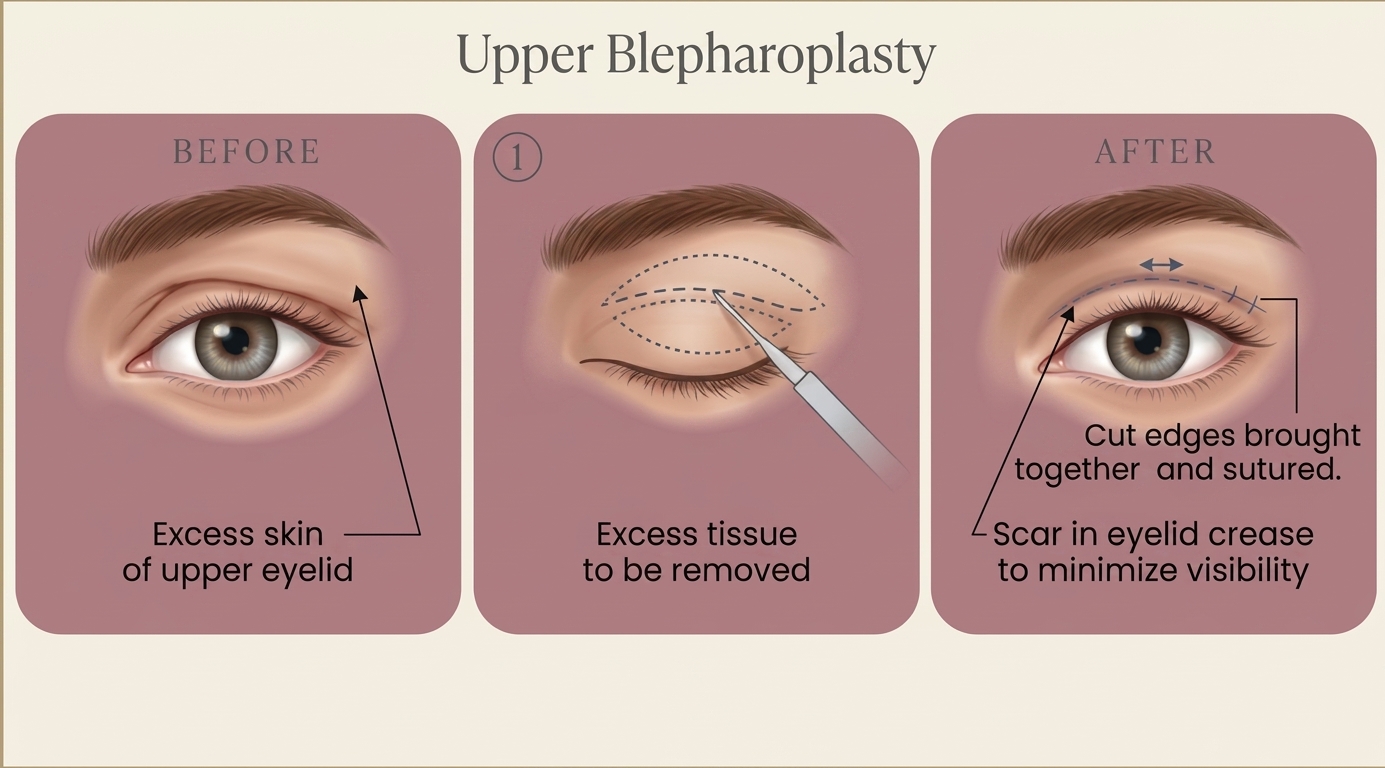
Upper eyelid surgery, known clinically as upper blepharoplasty, is a procedure that removes excess skin from the upper eyelids. In some cases, it also addresses excess fat and muscle tissue. The incision is placed within the natural eyelid crease, making the scar nearly invisible once healed.
This surgery treats a condition called dermatochalasis, the medical term for excess upper eyelid skin that creates a hooded appearance. When dermatochalasis is severe enough, the redundant skin folds over the lash line and can actually block peripheral vision, turning what seems like a cosmetic concern into a functional one.
What upper blepharoplasty corrects
Hooded upper eyelids caused by excess skin
A heavy, tired appearance around the eyes
Visual field obstruction in advanced cases
Asymmetry between the upper eyelids
Recovery snapshot
Most patients return to work within 7 to 10 days after upper blepharoplasty. Bruising and swelling peak around days 2 through 4, then gradually resolve. Results from upper eyelid surgery typically last seven years or more, though individual results vary based on skin quality, genetics, and lifestyle factors.
Upper blepharoplasty is consistently one of the most popular cosmetic procedures in the world. In 2024, ASPS member surgeons performed 120,755 blepharoplasty procedures in the United States alone. Globally, more than 2.1 million eyelid surgeries were performed that same year, a 13.4% increase that pushed blepharoplasty past liposuction for the first time.
What Is a Brow Lift (Forehead Lift)?
A brow lift, also called a forehead lift, is a surgical procedure that elevates the eyebrows to a more youthful position. It rejuvenates the upper third of the face by increasing the vertical distance between the eyes and brows, smoothing forehead wrinkles, and reducing the frown lines between the eyebrows.
The procedure creates a more alert, refreshed, and approachable appearance. It is particularly effective for patients whose brows have descended below the orbital rim (the bony ridge above the eye socket), causing heaviness that gets blamed on the eyelids.
Types of brow lift procedures
Not all brow lifts are the same. The technique your surgeon recommends depends on where the descent is occurring, how severe it is, and your hairline and forehead proportions.
Type | How It Works | Best For |
|---|---|---|
Endoscopic | 3 to 5 small incisions behind the hairline; camera-guided | Moderate to severe brow ptosis with a normal forehead height |
Temporal (Lateral) | Small incisions in the hairline above the temples | Early descent of the outer brow; commonly paired with upper blepharoplasty |
Open (Coronal) | Ear-to-ear incision across the scalp | Severe ptosis; patients requiring hairline adjustment |
Direct | Incision directly above the eyebrow | Elderly patients, typically thick-browed males |
Transblepharoplasty Browpexy | Performed through the upper blepharoplasty incision | Mild brow ptosis addressed during eyelid surgery |
The temporal brow lift deserves special attention because it targets the outer one-third of the brow, which is the portion that drops first with aging. This makes it the most common type performed alongside upper eyelid surgery. For a deeper comparison, see this guide to brow lift types and recovery.
A browpexy is worth knowing about, too. This technique anchors the brow’s soft tissue to the bone through the same incision used for upper blepharoplasty, providing stabilization or a mild lift without a separate brow lift procedure.
Recovery snapshot
Brow lift recovery takes one to two weeks with activity restrictions. Swelling and bruising are more significant than with blepharoplasty alone, particularly in the first 5 to 7 days. Most patients feel comfortable returning to social activities after about two weeks.
Key Terms You Should Know
Understanding the vocabulary of periorbital rejuvenation (the collective term for procedures that refresh the area around the eyes) helps you make sense of what your surgeon is describing and why.
Brow Ptosis
The descent of the eyebrow from its normal anatomical position to a point where it either looks cosmetically displeasing or creates visual field problems. Brow ptosis is the condition a brow lift corrects.
Dermatochalasis
Excess upper eyelid skin that creates a hooded appearance. This is exactly what upper blepharoplasty removes. It’s important to distinguish dermatochalasis from brow ptosis because the treatments are different, even though both conditions look similar to the untrained eye.
Ptosis (Eyelid Ptosis)
Drooping of the upper eyelid margin itself, caused by weakness of the levator muscle. This is a separate condition from both brow ptosis and dermatochalasis. With eyelid ptosis, the eyelid’s edge covers part of the pupil. Treatment requires ptosis repair (a different surgical technique), not standard blepharoplasty or a brow lift.
Lateral Hooding
Heaviness concentrated at the outer corners of the eyes. This is commonly mistaken for an eyelid problem, but it’s usually caused by descent of the lateral brow. The outer brow drops first because the frontalis muscle (the forehead muscle responsible for raising the brows) does not extend all the way to the outer corners. Without muscular support, that lateral portion sags earlier and more severely than the central brow.
Frontalis Muscle
The forehead muscle that elevates the eyebrows. When brow ptosis develops, many people unconsciously recruit the frontalis to hold their brows up, which creates horizontal forehead wrinkles. A brow lift repositions the brow so the frontalis doesn’t have to work overtime, often softening forehead lines as a secondary benefit.
Brow Lift vs. Upper Blepharoplasty: How to Tell Which You Need
This is the most important section of this guide, and the one most competitor pages skip entirely.
Many patients walk into a consultation saying “I need my eyelids done” when the real problem, fully or partially, is brow position. The eyelids themselves may have perfectly normal skin, but the descended brow pushes tissue downward and creates the appearance of hooding. Removing eyelid skin in this scenario gives a suboptimal result and can even make the brow look heavier.
A simple anatomy-based framework
Here is how surgeons evaluate whether you need upper eyelid surgery, a brow lift, or both:
If the brow sits at or below the orbital rim: A brow lift is likely needed. The heaviness you’re seeing comes from the brow pushing tissue onto the eyelid, not from the eyelid itself having too much skin.
If the brow position is good but excess skin folds over the eyelid crease: Upper blepharoplasty alone will address the problem. The brow is where it should be; the eyelid just has redundant skin.
If both brow descent AND excess eyelid skin are present: A combined upper eyelid surgery and brow lift approach gives the best result. This is the most common scenario in patients over 45.
If the eyelid margin itself covers the pupil: You may need ptosis repair rather than (or in addition to) blepharoplasty. This involves tightening the levator muscle and is a fundamentally different procedure.
Why anatomy matters more than age
A brow lift is the better choice when sagging eyebrows are creating heaviness over the eyes. Blepharoplasty is the better choice when excess eyelid skin is the main issue. The right option is determined by anatomy, not by age or appearance alone. A 38-year-old with genetically low brows may need a brow lift, while a 60-year-old with good brow position may only need blepharoplasty.
The bottom line: you can’t diagnose this from a mirror or a photo. An in-person examination, where the surgeon manually elevates the brow to see how much “eyelid” heaviness disappears, is the only reliable way to determine the correct plan.
Learn what to expect at a consultation so you can prepare for this kind of evaluation.
Why Upper Eyelid Surgery and Brow Lift Are Often Combined
When both brow descent and excess eyelid skin contribute to the problem, performing one surgery without the other leaves the job half done, or worse, creates an unnatural result.
Practical benefits
Single recovery period. Instead of two separate surgeries, two rounds of anesthesia, and two recoveries, you heal from both procedures at once. Combining does mean somewhat longer downtime compared to blepharoplasty alone, because the brow lift component causes more swelling and bruising. But one recovery is faster and easier than two sequential recoveries.
Lower total cost. When both procedures are performed in the same operative session, you pay one anesthesia fee and one facility fee instead of two. Typical savings from combining range from $1,500 to $3,500. For context, the average upper blepharoplasty surgeon’s fee is approximately $3,359 according to ASPS, while brow lift costs vary widely depending on technique, ranging from roughly $5,000 to $15,000. For a more detailed breakdown, see this blepharoplasty cost guide.
Fewer incisions. A combined approach often means fewer total incisions than if the surgeries were staged separately. This minimizes scarring and reduces overall surgical trauma. With a temporal brow lift specifically, the incision is hidden in the hairline, and the blepharoplasty incision sits within the natural eyelid crease.
What About Non-Surgical Alternatives?
For patients with very mild brow descent who aren’t ready for surgery, BOTOX Cosmetic can create a subtle brow lift effect. Strategic injection of the muscles that pull the brow down (the orbicularis oculi, corrugator, and procerus) allows the frontalis to elevate the brow unopposed.
The effect is modest, typically 1 to 3 millimeters of lift, and temporary (3 to 4 months). It works best for patients in their 30s and early 40s with minimal descent. It will not replace a surgical brow lift for moderate or severe ptosis, but it can buy time or help patients decide if they like the effect of a higher brow position before committing to surgery.
Considering a Combined Approach as Part of Broader Facial Rejuvenation
Upper eyelid surgery and brow lift address the upper face, but they’re often part of a larger conversation about facial rejuvenation. Some patients combine upper face procedures with a facelift and neck lift for comprehensive results from forehead to jawline, again benefiting from a single recovery window.
Others add facial fat grafting to restore volume lost with aging, particularly in the temples and under the eyes. These decisions are highly individual and depend on your anatomy, goals, and how much downtime you can accommodate.
Frequently Asked Questions
Do I need a brow lift or just eyelid surgery?
The answer depends on where the heaviness is coming from. If your brows sit at or below the orbital rim, you likely need a brow lift. If your brow position is good but you have excess skin folding over your eyelid crease, blepharoplasty alone may be sufficient. Many patients need both. An in-person examination where the surgeon manually lifts the brow is the most reliable way to tell. This distinction matters because treating the wrong structure gives a suboptimal result.
Can upper eyelid surgery and a brow lift be done at the same time?
Yes, and it’s the preferred approach when both issues are present. Performing them together means one anesthesia session, one facility fee, one recovery period, and a coordinated surgical plan that accounts for both the brow and eyelid simultaneously. Staging them separately costs more, requires two recoveries, and makes it harder for the surgeon to calibrate how much skin to remove from the eyelids.
Will a brow lift make me look surprised?
The “surprised” look comes from over-elevation of the brow, not from the procedure itself. Modern techniques, particularly the temporal (lateral) brow lift, focus on raising the outer portion of the brow while leaving the medial brow in a natural position. This creates a refreshed, alert look without the wide-eyed appearance that older techniques sometimes produced. Communicating your aesthetic goals clearly with your surgeon is the best way to prevent this.
How long do the results last?
Upper blepharoplasty results typically last around seven years or more. Brow lift longevity varies by technique, with endoscopic and open approaches generally lasting longer than temporal lifts. Aging continues after any procedure, so results are not permanent, but both surgeries effectively turn back the clock and slow the visible progression of descent and hooding.
Is a brow lift riskier than blepharoplasty?
A brow lift is a more involved procedure with a somewhat longer recovery. Combining it with blepharoplasty results in more swelling and bruising than blepharoplasty alone. However, both procedures have strong safety profiles when performed by a plastic surgeon. The main trade-off is a few extra days of downtime for a significantly better overall result.
What should I expect at a consultation for these procedures?
A thorough consultation includes a medical history review, a physical examination of your brow position and eyelid skin, a discussion of your goals, and an honest assessment of which procedures will achieve those goals. Expect your surgeon to manually elevate your brow during the exam to see how much of the perceived eyelid heaviness resolves. You should also learn about risks, alternatives, and recovery expectations before making any decisions.
How can I start exploring whether upper eyelid surgery and brow lift are right for me?
The first step is a consultation with a plastic surgeon who can evaluate your anatomy and explain your options clearly. Understanding the difference between brow descent and eyelid excess is something you can research on your own, but confirming the diagnosis requires a hands-on examination.
Schedule a consultation to discuss your upper face concerns and find out which approach, blepharoplasty, brow lift, or both, fits your anatomy and goals.