
Mini Tummy Tuck vs Full Tummy Tuck: 2026 Comparison

TL;DR
A mini tummy tuck targets excess skin and fat below the belly button with a shorter incision, quicker recovery, and no belly button repositioning. A full tummy tuck addresses the entire abdomen, repairs separated muscles (diastasis recti), and repositions the belly button. Your anatomy, not your preference for a smaller scar, should determine which procedure you need. Most post-pregnancy patients and those with muscle separation are better served by a full tummy tuck.
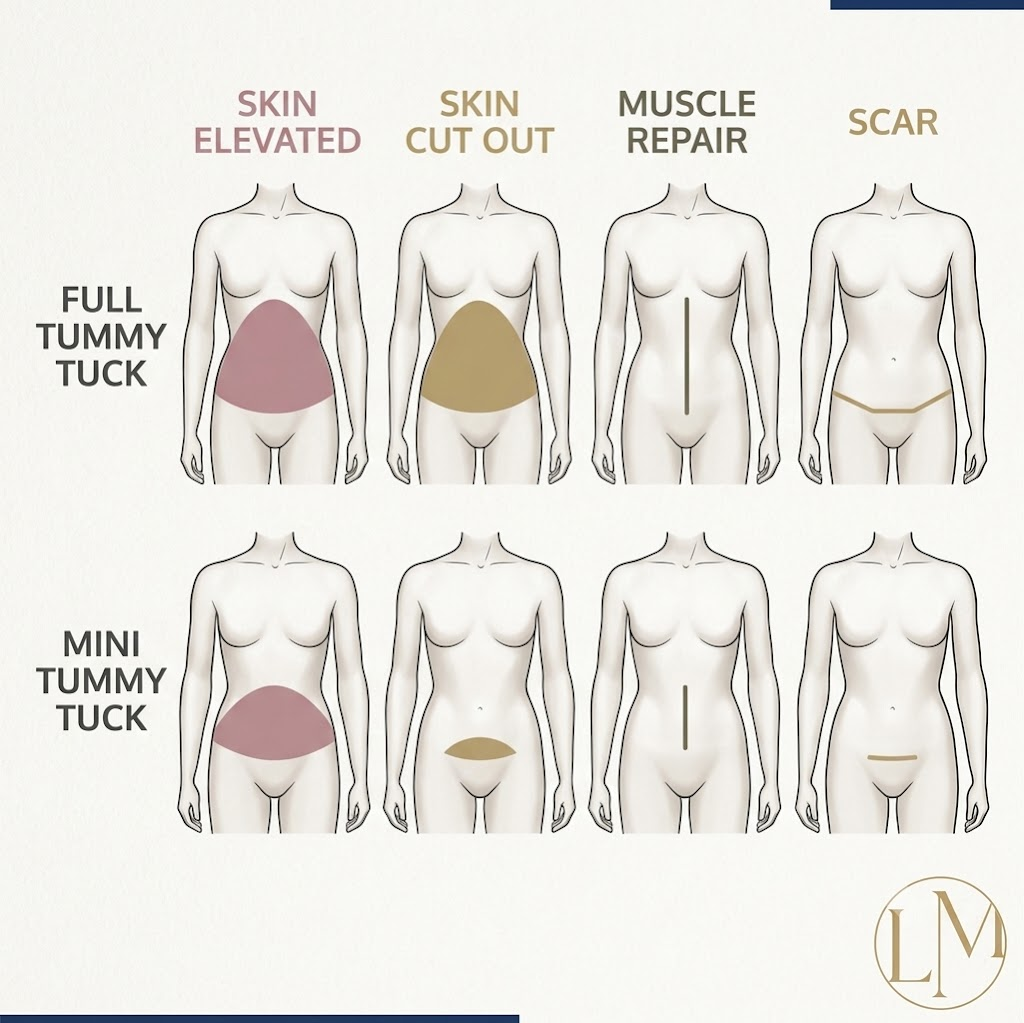
The question isn’t really “which tummy tuck do I want?” It’s “which tummy tuck does my body need?”
That distinction matters more than most people realize when comparing a mini tummy tuck vs full tummy tuck. Patients often walk into consultations hoping they qualify for the mini version because it sounds easier, faster, less intimidating. But plastic surgeons consistently point out that the decision is based on anatomy, not on how much improvement someone desires. Choosing the wrong procedure leads to disappointing results, and sometimes a second surgery.
This guide breaks down every meaningful difference between these two procedures so you can walk into your consultation informed and ready to have the right conversation.
Learn more about tummy tuck options with Dr. Leela Mundra in Denver.
Quick Definitions
Mini Tummy Tuck (Mini Abdominoplasty)
A mini tummy tuck is a cosmetic procedure that removes excess skin and fat from the lower abdomen, specifically the area between the belly button and the pubic bone. It uses a single, shorter incision (typically under 6 inches), involves little to no muscle repair, and leaves the belly button untouched. Think of it as a targeted fix for a small lower belly pouch that won’t respond to diet or exercise.
Full Tummy Tuck (Standard Abdominoplasty)
A full tummy tuck is a comprehensive procedure addressing the entire abdomen from the rib cage down to the pubic area. It involves a hip-to-hip incision, full repair of separated abdominal muscles, removal of excess skin above and below the belly button, and repositioning of the navel to sit naturally on the newly tightened abdominal wall. This is the procedure most people picture when they hear “tummy tuck.”
Diastasis Recti
Diastasis recti is the separation of the left and right rectus abdominis muscles along the midline of the abdomen. It commonly occurs after pregnancy or significant weight fluctuations. This condition creates a visible bulge or dome shape in the midsection that no amount of crunches will fix. It’s one of the single most important factors determining whether you need a mini or full procedure.
Mini Tummy Tuck vs Full Tummy Tuck: Side-by-Side Comparison
Feature | Mini Tummy Tuck | Full Tummy Tuck |
|---|---|---|
Treatment area | Below the belly button only | Entire abdomen (above and below belly button) |
Incision length | Less than 6 inches, below the panty line | Hip to hip, plus around the belly button |
Muscle repair | Limited or none | Full diastasis recti repair |
Belly button | Stays in place | Repositioned to look natural |
Operating time | 2 to 3 hours | 3 to 5 hours |
Recovery to light activity | 1 to 2 weeks | 2 to 4 weeks |
Final results visible | 6 to 9 months | 9 to 12 months |
Best for | Small lower belly pouch, good skin elasticity, intact muscles | Post-pregnancy laxity, muscle separation, excess skin above and below navel |
Key Differences Explained
Treatment Area
This is the most fundamental distinction. A mini tummy tuck only addresses the lower abdomen, the strip of skin and tissue between your belly button and your pubic area. If your concern is limited to a small pouch that sits right above your waistband, this might be enough.
A full tummy tuck treats everything from the rib cage down. If you’re looking to flatten your entire stomach, tighten stretched skin across your midsection, and restore definition to your waistline, the full procedure is the appropriate choice.
Incision and Scarring
The mini tummy tuck uses a single incision, usually less than 6 inches long, placed low enough to hide beneath underwear or a bikini bottom. No incision is made around the belly button.
A full tummy tuck requires a longer incision running from hip to hip, plus a second incision around the navel for repositioning. The scar is longer, but it’s still placed low on the abdomen and is typically concealed by swimsuits and underwear. For a deeper look at how scars evolve over time, our guide on tummy tuck scar timeline walks through what to expect month by month.
Muscle Repair and Diastasis Recti
This is where the two procedures diverge most significantly. A mini tummy tuck involves minimal or no muscle tightening. It works best for people whose abdominal wall is still intact.
A full tummy tuck includes comprehensive repair of the rectus abdominis muscles. If you have diastasis recti, a full tummy tuck is the procedure that will actually address it. The surgeon sutures the separated muscles back together along the midline, creating a tighter, flatter abdominal wall that diet and exercise simply cannot achieve on their own.
Our detailed guide covers the specifics of tummy tuck with muscle repair if you want to understand exactly what this involves.
Belly Button Repositioning
With a mini tummy tuck, your belly button stays exactly where it is. Nothing about it changes.
During a full tummy tuck, the surgeon creates a new opening for the navel and carefully shapes it to look natural on the tightened skin. This step is necessary because the significant amount of skin being removed and re-draped would otherwise distort the navel’s position.
Recovery Timeline
A mini tummy tuck generally allows a return to light activities within 2 weeks. Because muscle repair is minimal or absent, there’s less internal healing required.
A full tummy tuck demands more patience. Most patients need 2 to 4 weeks before returning to light activities, and strenuous exercise is typically off-limits for 6 to 8 weeks. The muscle repair component adds healing time and discomfort in the first two weeks.
For both procedures, swelling can persist for three to six months. Final contour and scar appearance aren’t fully settled until about nine to twelve months post-surgery.
Who Is a Candidate for Each Procedure?
Ideal Mini Tummy Tuck Candidate
The ideal mini abdominoplasty candidate has good skin elasticity with only minor excess skin below the belly button, does not have significant diastasis recti, is at or near their goal weight, and has a small lower belly pouch that persists despite consistent diet and exercise. They should also have minimal fat deposits in the waist and flanks.
It’s worth stating clearly: few people are truly ideal candidates for a mini tummy tuck. The procedure serves a narrow population. If you’re reading this and wondering whether you qualify, there’s a reasonable chance the answer is no.
For a more detailed breakdown, our guide on mini tummy tuck candidacy covers the specific criteria.
Ideal Full Tummy Tuck Candidate
A full tummy tuck is appropriate when there’s excess skin both above and below the belly button, significant muscle separation (diastasis recti), a stretched abdominal wall from pregnancy or major weight loss, or a desire for comprehensive contouring including waist definition.
Most women who have had one or more pregnancies fall into this category. The combination of stretched skin, separated muscles, and stubborn fat deposits across the full abdomen makes the full procedure the right tool for the job.
The Anatomy-First Principle
This deserves emphasis. Plastic surgeons base the recommendation on the patient’s anatomy, not on the level of improvement the patient desires. A “full” abdominoplasty isn’t chosen because someone wants dramatic results, and a “mini” isn’t chosen because someone wants subtle changes. The body dictates the procedure.
Wanting a shorter scar or faster recovery doesn’t change what your anatomy requires. This is one of the most important things to understand before your consultation.
Schedule a consultation to determine which procedure fits your specific anatomy.
Can You Convert a Mini Tummy Tuck to a Full Later?
Yes, it’s technically possible. But it means a second surgery. The total expense of doing a mini followed by a full will almost always exceed the cost of simply doing the full procedure the first time.
The takeaway is straightforward: getting the right procedure the first time saves money, time, and emotional energy.
Weight Stability and Timing
A tummy tuck is not a weight loss procedure. Having one before your weight has stabilized is one of the most common and most avoidable causes of regret.
Surgeons generally recommend being at or close to your stable, goal weight before proceeding. For women, completing your family first is equally important. A pregnancy after a tummy tuck will stretch the repaired muscles and skin, potentially undoing the results entirely.
There is no rush. The procedure will work better and last longer when the timing is right.
Combining a Tummy Tuck With Other Procedures
Liposuction is frequently combined with both mini and full tummy tucks. Many patients who get a standalone tummy tuck end up with a flat stomach but feel their hips or flank areas look blocky by comparison. Adding liposuction to the sides and lower back (sometimes called “360 contouring”) creates a smoother, more proportional silhouette.
For women addressing post-pregnancy changes, combining a tummy tuck with a breast lift or breast augmentation in a single surgical session, often called a mommy makeover, reduces total downtime compared to staging the procedures separately.
Other body contouring procedures like an arm lift or thigh lift can also be discussed if you’re addressing changes from significant weight loss.
What to Ask Your Surgeon
Bring these questions to your consultation. They’ll help you and your surgeon determine whether a mini or full tummy tuck is right for your body.
Do I have diastasis recti? This is the single biggest factor. If the answer is yes, you almost certainly need a full tummy tuck.
Is my skin laxity above the belly button, below it, or both? This tells you whether a mini can address the problem or whether you need the full procedure.
Would liposuction alone address my concern? Some patients don’t need a tummy tuck at all. If your skin elasticity is good and the issue is primarily fat, lipo might be sufficient.
What will my results look like if we do a mini instead of a full? Ask your surgeon to be specific about limitations.
What is the realistic recovery timeline for my situation? Individual factors like your health, the extent of repair, and whether you’re combining procedures all affect this.
Do you recommend combining this with liposuction or any other procedure? Understanding the full plan upfront helps with budgeting and recovery planning.
Can I see before-and-after photos of patients with a similar body type? This gives you the most realistic sense of what to expect.
Not sure what a plastic surgery consultation involves? Our overview of what to expect at a consultation walks through the process step by step.
Frequently Asked Questions
Is a mini tummy tuck worth it?
For the right candidate, absolutely. If you have a small lower belly pouch, good skin elasticity, and no muscle separation, a mini tummy tuck delivers targeted improvement with a shorter recovery. The problem is that most people who think they’re candidates for a mini actually need a full. The procedure is worth it when it matches your anatomy. It’s not worth it when it’s chosen to avoid a bigger surgery that your body actually requires.
How do I know if I need a mini tummy tuck or a full tummy tuck?
The two biggest factors are where your excess skin sits and whether you have diastasis recti. If your concerns are limited to below the belly button and your abdominal muscles are intact, a mini may work. If you have loose skin above and below the navel, or any degree of muscle separation, a full tummy tuck is the appropriate choice. A plastic surgeon can determine this through a physical exam during your consultation.
How long does it take to see final results?
For a mini tummy tuck, most swelling resolves within three to six months, with final results visible around six to nine months. For a full tummy tuck, meaningful swelling can persist for six months, and the final abdominal contour and scar appearance typically settle around nine to twelve months post-surgery.
Can I get a tummy tuck if I plan to have more children?
You can, but most surgeons advise against it. A future pregnancy will stretch the repaired muscles and skin, potentially reversing your results. The recommendation is to complete your family before having a tummy tuck to protect the longevity of the outcome.
What is an extended tummy tuck?
An extended tummy tuck goes beyond the standard full procedure by also addressing the flanks and lower back. It’s typically recommended for patients who have experienced major weight loss and have excess skin wrapping around their sides.
Ready to find out which procedure your body actually needs? Contact our Denver office to schedule a consultation with Dr. Leela Mundra, a Harvard-trained plastic surgeon who takes an education-first approach to helping patients make confident decisions about their care.