
Saline vs Silicone Implants Comparison: 2026 Guide
Saline vs. Silicone Implants: A Complete Comparison
TL;DR: Saline and silicone breast implants both have silicone outer shells but differ in fill material, feel, cost, rupture detection, and long-term monitoring needs. Silicone generally feels softer and shows less visible rippling, making it the more popular choice today, especially for patients with less natural breast tissue. Saline tends to cost less, allows smaller incisions, and makes rupture immediately obvious. The right answer in any saline vs. silicone implants comparison comes down to anatomy, aesthetic goals, budget, and willingness to maintain follow-up imaging.
This article is educational and is not a substitute for a consultation with a plastic surgeon.
What Does “Saline vs. Silicone” Actually Mean?
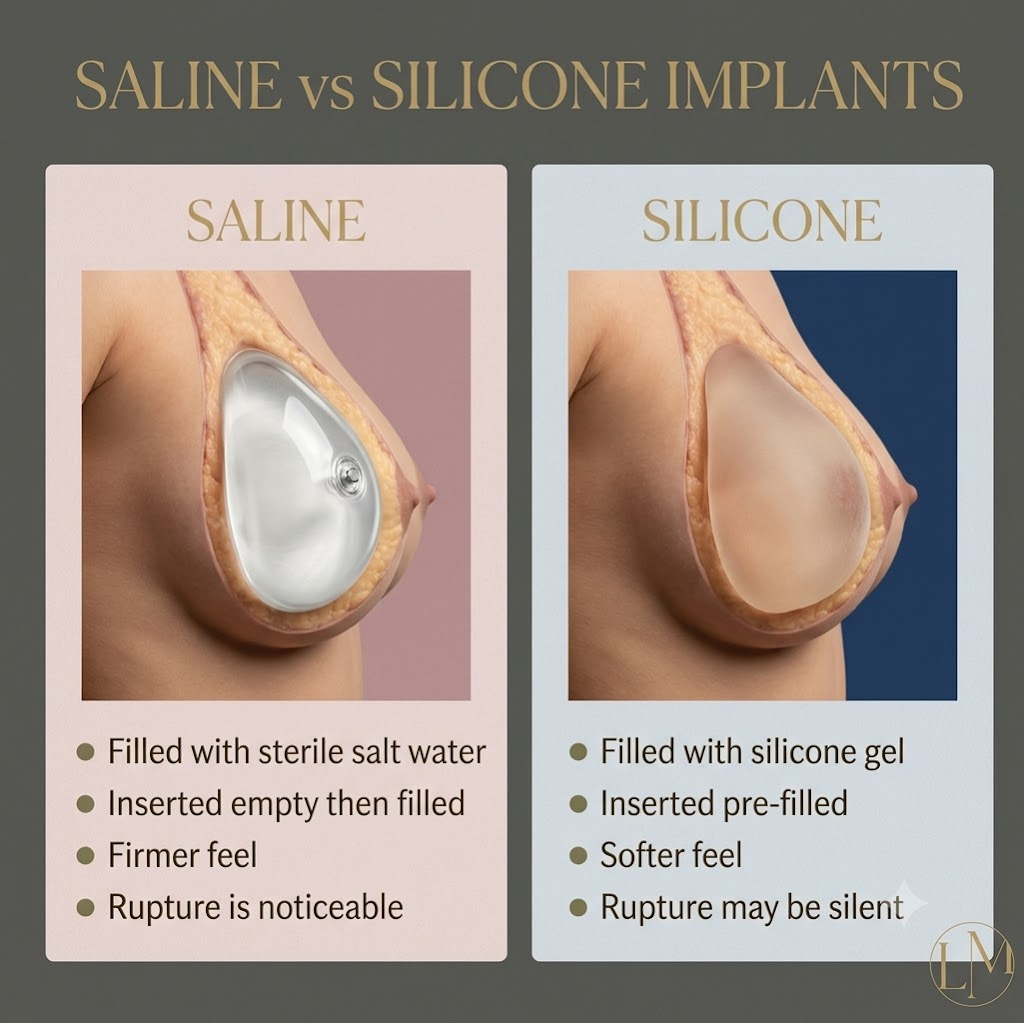
Both saline and silicone breast implants have a silicone outer shell. The difference is what fills that shell. A saline implant contains sterile saltwater. A silicone implant contains cohesive silicone gel. These are the two FDA-approved fill categories for breast implants.
That fill material changes how the implant feels against the body, how large the incision may need to be, how a rupture is detected, what kind of follow-up imaging is recommended, and what the device costs. The saline vs. silicone implants comparison is really about understanding those tradeoffs so you can have a more productive conversation with your surgeon.
If you are already weighing these options for a procedure, a breast augmentation consultation is where this comparison becomes specific to your body and goals.
What Are Saline Breast Implants?
Saline implants are filled with sterile saltwater. They are typically inserted empty and then filled once the surgeon has positioned them, allowing smaller incisions and some intraoperative volume adjustment within the manufacturer’s allowed range.
Key characteristics:
Fill: Sterile saltwater (saline)
FDA augmentation age: 18 and older
Rupture sign: The implant usually deflates visibly. The body absorbs the saline without harm, but the remaining shell still requires surgical removal or replacement.
Feel: Firmer and more uniform than silicone. Some patients describe it as a “water balloon” sensation, especially when tissue coverage is thin.
Incision: Often smaller because the implant is filled after placement
Saline remains a practical option for patients who value obvious rupture detection, lower device cost, or who are between ages 18 and 21 and pursuing cosmetic augmentation (since silicone is not FDA-approved for cosmetic augmentation until age 22).
The main drawback is feel. Patients with less natural breast tissue covering the implant often notice the firmer texture and may see visible rippling.
What Are Silicone Breast Implants?
Silicone implants arrive prefilled with silicone gel. They generally feel softer and more similar to natural breast tissue, which is the primary reason they have become the more commonly chosen option.
Key characteristics:
Fill: Cohesive silicone gel
FDA augmentation age: 22 and older (available at any age for reconstruction)
Rupture sign: May be “silent.” Gel can remain contained within the shell or surrounding scar capsule, so a rupture may produce no visible change.
Feel: Softer, more breast-like
Incision: Usually slightly larger because the implant is prefilled
Cost: Generally more expensive than saline
Silicone implants come in varying gel cohesivities, profiles, and shapes. Modern options include brands like Motiva implants, Sientra, and Natrelle, each with distinct gel formulations suited to different body types and aesthetic goals.
The tradeoff: because silicone rupture can be silent, the FDA recommends imaging surveillance for asymptomatic patients. More on that below.
Saline vs. Silicone: Side-by-Side Comparison
Factor | Saline | Silicone |
|---|---|---|
Fill material | Sterile saltwater | Silicone gel |
Outer shell | Silicone | Silicone |
FDA augmentation age | 18+ | 22+ |
Feel | Firmer, more uniform | Softer, more breast-like |
Rippling risk | Higher, especially with thin tissue | Lower |
Incision size | Often smaller | Often slightly larger |
Rupture detection | Usually obvious deflation | May be silent |
Imaging follow-up | Not typically required for rupture | Ultrasound or MRI recommended |
Adjustable during surgery | Yes, within allowed range | No (prefilled) |
This table captures the core of the saline vs. silicone breast implants comparison, but anatomy and surgical planning fill in the details a table cannot.
Which Implant Feels More Natural?
Silicone generally wins on feel. The Mayo Clinic states that most people believe silicone implants look and feel more like natural breasts. ASPS surgeons describe modern silicone gel implants as softer and more natural than saline.
But “natural” is a word that means different things to different patients. ASPS practitioners point out that bringing goal photos to a consultation is more helpful than simply asking for a “natural result,” because the word can mean softness, shape, movement, upper-pole fullness, or something entirely personal.
Feel depends on more than fill material:
Tissue coverage. Patients with more natural breast tissue have more padding over the implant, which softens the feel of either type.
Implant placement. Submuscular (under the muscle) placement adds another tissue layer, improving both feel and reducing visibility.
Size and profile. A large implant on a small frame will feel different than a proportionate one, regardless of fill.
Skin elasticity. How the implant settles and moves depends partly on skin quality.
The fill choice matters, but it is one piece of a larger plan. For a deeper look at how modern silicone gel options produce soft, proportionate outcomes, this natural silicone implants guide covers the topic in more detail.
Rippling: Why Tissue Coverage Matters More Than You Think
Rippling, the visible or palpable wrinkling of the implant surface through the skin, is one of the most underestimated factors when comparing saline and silicone implants.
Saline implants carry a higher rippling risk. This is especially noticeable in:
Thin patients with little natural breast tissue or body fat
Larger implants that stretch the available tissue
Above-muscle (subglandular) placement, where there is less padding
Textured surface implants
Silicone gel is denser and holds its shape with fewer visible folds. That said, rippling is not inevitable with saline. Patients with adequate tissue, moderate implant sizing can still get good results with a saline fill. The key is an exam-based plan that accounts for tissue thickness and implant dimensions, not just the fill label on the box.
What Happens if an Implant Ruptures?
Rupture is possible with both implant types, and the difference in how it presents is one of the most meaningful distinctions in any saline versus silicone comparison.
Saline rupture is usually obvious. The implant deflates, the breast visibly changes shape and size, and the sterile saltwater is harmlessly absorbed by the body. Surgery is still needed to remove the remaining shell and place a new implant if desired.
Silicone rupture can be silent. The gel may stay contained inside the shell or the surrounding scar capsule, so the patient may notice nothing at all. Over time, a ruptured silicone implant may cause pain, thickening, or changes in breast shape, but it can also go undetected without imaging.
The FDA considers MRI the most effective method for detecting silent silicone rupture, with ultrasound as an acceptable screening alternative for asymptomatic patients.
For patients who already have implants and suspect rupture or want to switch fill types, implant exchange is a procedure designed to address these situations.
Some patients choose saline specifically because the idea of silent rupture makes them anxious. Others choose silicone for the feel and accept the imaging plan. Both are reasonable positions.
Follow-Up Imaging and Long-Term Monitoring
All breast implants require long-term monitoring. Silicone implants carry a specific imaging recommendation that patients should understand before making their choice.
Current FDA-aligned guidance for silicone implants:
First ultrasound or MRI at 5 to 6 years after surgery
Repeat imaging every 2 to 3 years after that
This applies to asymptomatic patients (no signs of rupture)
Saline implants do not carry the same routine imaging recommendation because rupture is typically self-evident through visible deflation.
Mammograms and implants. Patients with either type of breast implant should tell their mammography provider. Implants may require specialized views and can make some breast tissue harder to evaluate, according to the Mayo Clinic.
Are Saline or Silicone Implants Safer?
Neither is universally safer. Both are FDA-approved medical devices. Both carry risks. The FDA states that breast implants are not lifetime devices and that longer implant duration increases the likelihood of complications, some requiring additional surgery.
The most frequent complications reported for breast implant patients include capsular contracture, reoperation, implant removal, rupture, wrinkling, asymmetry, scarring, pain, and infection. These apply to both saline and silicone.
BIA-ALCL
Breast implant-associated anaplastic large cell lymphoma (BIA-ALCL) is a rare but serious cancer of the immune system (not breast cancer) that develops in the tissue around an implant. The FDA has identified that BIA-ALCL risk is higher with textured surface implants than smooth surface implants. Based on current data, fill type (saline versus silicone) does not appear to be a primary risk factor, though the FDA notes this has not been studied in a large epidemiologic trial.
As of June 30, 2024, the FDA had received 1,380 U.S. and worldwide medical device reports mentioning BIA-ALCL, including 64 reported deaths. Among reported cases, 73% involved textured implants, 3% smooth, and 24% had unspecified surface type.
Breast Implant Illness
Some patients report systemic symptoms, including fatigue, joint pain, and cognitive changes, that they associate with their implants. The FDA requires strengthened labeling that communicates these reported symptoms. Patients with a history of autoimmune conditions or concerns about systemic symptoms should raise these during their consultation.
The bottom line on safety: the saline vs. silicone implants comparison is not primarily a safety question. It is a tradeoff question about feel, rupture detection, monitoring commitment, and personal comfort with each material.
How Long Do Breast Implants Last?
Implants are not lifetime devices, but they also do not come with a mandatory expiration date.
The FDA states that no one can predict exactly when additional surgery will be needed. A 2025 pooled registry study in JAMA Surgery found 5-year complication-related revision rates of 1.2% for cosmetic implants, with no significant difference between implant types at that time point. Some patients keep implants well over a decade without problems. Others need earlier revision for rupture, capsular contracture, size change, malposition, or evolving aesthetic goals.
The “replace every 10 years” depends on your physique. A better approach: plan for the possibility of future surgery, maintain recommended follow-up, and allocate the idea for a potential revision breast augmentation down the road.
Who May Prefer Saline Implants?
Saline may be a strong fit if you:
Are between 18 and 21 and pursuing cosmetic augmentation (silicone is not FDA-approved for augmentation until age 22)
Want the most obvious rupture detection
Prefer a smaller incision
Have enough natural tissue coverage that the firmer feel and potential rippling are less concerning
Value intraoperative fill adjustability for asymmetry correction
Feel more comfortable with saltwater than gel inside your body
Who May Prefer Silicone Implants?
Silicone may be a strong fit if you:
Prioritize the softest, most breast-like feel
Have less natural breast tissue and want to minimize visible rippling
Are 22 or older
Accept the higher device cost
Are comfortable with the FDA’s imaging recommendation for silent rupture screening
Want access to a wider range of gel cohesivities and profiles
Silicone is the aesthetic favorite in most saline vs. silicone implants comparisons, but it is not maintenance-free. Understanding the follow-up plan before surgery prevents surprises later.
For some patients, the best plan involves combining implants with an augmentation and lift to address both volume and sagging in a single procedure. Fill type matters, but so does the complete surgical plan.
The Decision Is Bigger Than Fill Material
The saline vs. silicone implants comparison gets the most attention online, but experienced surgeons will tell you that fill material is only one variable. Results also depend on:
Breast width and base diameter. These measurements determine which implant diameters look proportionate.
Soft tissue thickness. How much padding you have over the implant affects feel, visibility, and rippling.
Implant placement. Submuscular, subglandular, and dual-plane positioning each have tradeoffs.
Profile and projection. Low, moderate, and high-profile implants create different shapes on the same body.
Skin elasticity. Tight or loose skin changes how the implant settles.
Future plans. Pregnancy, weight changes, and aging all affect results over time.
ASPS practitioners emphasize that biodimensional planning, where body measurements guide implant selection, produces more predictable and proportionate outcomes than choosing a cup size from Instagram. A thoughtful consultation includes a physical exam, measurements, sizer trials, and a discussion of anatomy.
Learn what to expect during a consultation so you can prepare for this process.
Questions to Ask During Your Consultation
Bring this list to your appointment. These questions move the conversation from general comparison to a plan built around your body:
Based on my tissue thickness, am I more likely to see rippling with saline?
Which fill, size, profile, and placement best fit my frame?
What does a “natural result” look like for my anatomy specifically?
Do I need a lift in addition to implants, or will implants alone work?
What incision options are available for my implant choice?
What is my long-term monitoring plan, and what imaging timeline should I expect?
What happens if I develop rupture, capsular contracture, or want a size change later?
Which implant brands do you offer, and why?
What costs are included in the quoted fee, and what is not?
How should I handle future mammograms with implants?
Related Terms Worth Knowing
Cohesive gel (gummy bear) implants. Form-stable silicone gel implants that maintain their shape even if the shell is compromised. They tend to be firmer than standard silicone gel implants.
Structured saline implants. Saline-filled implants with an internal structure designed to improve the feel compared to traditional saline. ASPS lists these as a distinct option.
Capsular contracture. A condition where scar tissue around the implant tightens, squeezes, or hardens the implant. It is a risk with both saline and silicone.
Silent rupture. A silicone implant rupture that produces no visible or palpable signs. Detection typically requires ultrasound or MRI.
Smooth vs. textured implants. Smooth implants can move within the pocket. Textured implants develop scar tissue adherence. The FDA has identified higher BIA-ALCL risk with textured surfaces regardless of fill type.
Bottom Line
The saline vs. silicone implants comparison does not have one right answer. Silicone is usually the stronger choice for patients who prioritize soft, natural feel and lower visible rippling risk, particularly those with less natural tissue coverage. Saline is a solid choice for patients who value lower cost, obvious rupture detection, a smaller incision, or who are between 18 and 21. Both types are FDA-approved. Both carry risks. Neither is a lifetime device.
Fill material is important, but it is not the whole decision. Tissue coverage, implant size, placement, profile, skin quality, and surgical judgment all shape the final result. The best way to move from a general comparison to a specific plan is a one-on-one consultation where a surgeon examines your anatomy and discusses your goals in detail.
Contact Leela Mundra MD to schedule a personalized breast augmentation consultation in Denver.
Frequently Asked Questions
Which is better, saline or silicone breast implants?
Neither is universally better. Silicone is often preferred for a softer, more natural feel and lower visible rippling. Saline may be preferred for lower cost, smaller incision potential, FDA-approved augmentation starting at age 18, and obvious rupture detection. The best choice depends on anatomy, goals, and follow-up comfort.
Do silicone implants need MRI or ultrasound monitoring?
Yes. FDA labeling guidance recommends that asymptomatic silicone implant patients have their first ultrasound or MRI at 5 to 6 years after surgery, with follow-up imaging every 2 to 3 years after that. MRI is considered the most effective method for detecting silent rupture, and ultrasound is an acceptable screening alternative.
Are saline implants safer if they rupture?
Saline rupture is easier to detect because the implant deflates visibly and the saltwater is harmlessly absorbed. Silicone rupture can be silent and may need imaging to identify. Both types still require surgery to remove the shell or replace the implant after rupture.
Do breast implants need to be replaced every 10 years?
Not automatically. The FDA states that implants are not lifetime devices and future surgery may be needed, but no one can predict exactly when. Some patients go well beyond 10 years without problems. Others need earlier revision due to rupture, capsular contracture, or changing goals.
Which implant is better for thin patients?
Silicone is generally recommended for thin patients or those with less natural breast tissue. Silicone gel feels softer and is less likely to show visible rippling when tissue coverage is minimal.
Is BIA-ALCL caused by saline or silicone fill?
Based on current FDA data, BIA-ALCL risk is associated with textured surface implants, not with the fill material. Whether the implant contains saline or silicone does not appear to be a primary risk factor, though the FDA notes this has not been studied in a large epidemiologic trial. Symptoms to watch for include persistent swelling, a mass, or pain near the implant.
Can I breastfeed with implants?
Some patients breastfeed successfully after augmentation. Others cannot. Results depend on the incision approach, anatomy, and individual factors. This is an important question to bring up during a surgical consultation.