
Motiva Breast Implants Chart 2026: Profiles & Sizes

TL;DR
The Motiva breast implants chart organizes implant options by profile (Mini, Demi, Full), volume in cubic centimeters, and dimensions like base width and projection height. Understanding these terms before your consultation helps you communicate your goals more clearly with your surgeon. This guide breaks down every term on the chart, explains how profiles compare to other brands like Mentor, and clarifies why the numbers on the chart are only part of the story.
Why the Motiva Implant Chart Matters Before Your Consultation
If you’ve been researching breast augmentation, you’ve probably stumbled across a Motiva breast implants chart and felt a bit overwhelmed. Rows of numbers, unfamiliar profile names, multiple gel types. It can feel like reading a foreign language.
Here’s what the chart actually is: a matrix that maps out every available Motiva implant by its profile (how far it projects), its volume (measured in cc), and its physical dimensions (base width and projection height). The chart is the starting point, not the finish line. Your surgeon uses it alongside your body measurements to narrow down the right implant for your frame and goals.
This glossary explains every term you’ll encounter on that chart so you walk into your consultation informed and confident.
Learn more about Motiva implants offered at our Denver practice.
How to Read the Motiva Implant Chart
The Motiva implant matrix is organized along two main axes. One axis shows the profile levels (Mini, Demi, Full). The other axis shows volume in cubic centimeters. Within each cell, you’ll find the corresponding base width (diameter) and projection height.
The critical thing to understand: the same volume can look completely different depending on the profile. A 300cc Demi implant sits wider and flatter on the chest, while a 300cc Full implant is narrower and projects further forward. Practitioners on forums and surgeon Q&A sites consistently emphasize this point.
Here’s a simplified reference table showing how the four profiles relate to each other:
Profile | Projection Level | Base Width | Projection Height | Best For |
|---|---|---|---|---|
Mini | Lowest | Widest | Shortest (under 25mm) | Subtle, one-cup-size increase |
Demi | Moderate-Low | Moderate-Wide | Moderate-Low | Average chest width, gentle upper-pole fullness |
Full | Moderate-High | Moderate-Narrow | Taller | Narrow chest frames, two-plus cup size increase |
Globally, Motiva’s implant size range spans from 105cc to 1,050cc. For the U.S. market specifically (FDA-approved configurations), sizes range from roughly 150cc to 625cc, covering approximately an A through DDD cup result. Most breast augmentations in the U.S. use implants in the 200cc to 500cc range, which typically achieves a full C or D cup.
Motiva Implant Profiles Defined
The profile names are where most of the confusion starts. Motiva uses its own terminology rather than the traditional “low, moderate, high” labels you might see from other manufacturers. Here’s what each one means.
Mini Profile
Motiva Mini is the flattest option. The implant diameter is generally around 100mm, with a projection height under 25mm. It’s designed for women who want a very subtle boost, perhaps going up just one cup size. The result tends to look like a natural enhancement rather than an obvious augmentation. Mini works well for patients who already have some breast tissue and simply want more fullness without a significant change in silhouette.
Demi Profile
Demi sits one step above Mini in projection. The implant is slightly narrower than Mini, which gives it a bit more body and forward shape. This is the middle-of-the-road Motiva profile, well suited for patients with an average chest width and some existing breast tissue who want extra fullness in the upper pole and cleavage area. Think of it as a noticeable but still natural-looking enhancement.
Full Profile
Full is taller and narrower than both Mini and Demi, making it the go-to for patients who want greater forward projection. Surgeons often recommend Full for women with a narrow chest (band size 34 or smaller) and petite breasts who want to go up two or more cup sizes. The narrower base concentrates volume forward, creating a more prominent profile from the side view.
If you’re exploring what the full journey looks like from consultation through final results, our breast augmentation stages guide walks through the process step by step.
How Motiva Profiles Compare to Mentor
If you’ve researched other implant brands, this comparison table will help translate the terminology:
Motiva | Mentor Equivalent | Traditional Industry Term |
|---|---|---|
Mini | Moderate | Low Profile |
Demi | Moderate Plus | Moderate-Low Profile |
Full | High | Moderate-High Profile |
For a deeper comparison between these two brands, including gel feel and shell differences, see our Motiva or Mentor comparison guide. You can also explore how Motiva stacks up against Natrelle breast implants or Sientra breast implants.
Motiva Implant Types on the Chart
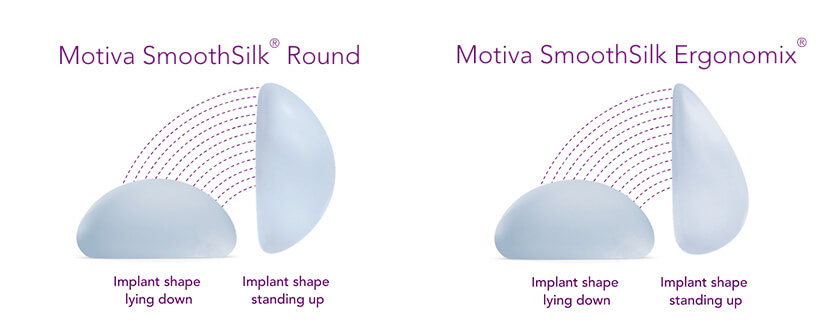
The Motiva breast implants chart doesn’t just show profiles and volumes. It also distinguishes between two main implant types: Round and Ergonomix. The type you choose affects how the implant behaves inside your body.
Round (ProgressiveGel Plus)
 974 × 493
Motiva Round implants are filled with ProgressiveGel Plus, a firmer silicone gel that maintains the implant’s full shape, especially in the upper pole. Whether you’re standing, lying down, or leaning forward, the implant keeps a consistent round appearance. Patients seeking visible upper-pole fullness and defined cleavage tend to prefer Round.
Ergonomix (ProgressiveGel Ultima)
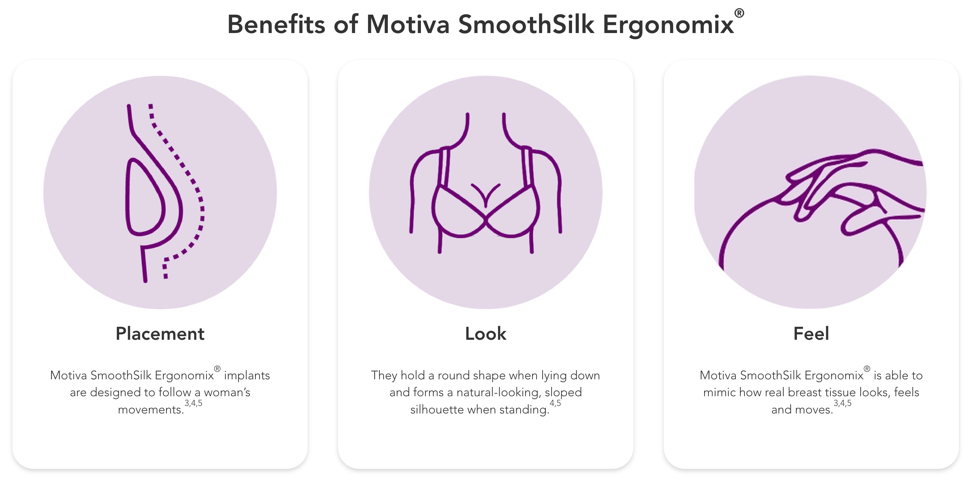
Ergonomix implants contain ProgressiveGel Ultima, a more flexible silicone gel that allows the implant to behave dynamically. When you’re standing, the implant settles into a teardrop shape. When you’re lying down, it spreads into a rounder form. This mimics how natural breast tissue moves.
Patients seeking a “natural” appearance and feel may favor Ergonomix because of this adaptive gel behavior. Patients interested in the natural feel may also opt for an augmentation with a lift.
On the Motiva chart, both Round and Ergonomix options appear across the same profile and volume ranges, so the type selection is independent of your size choice.
Key Measurements Explained
These are the numbers that fill the cells of the Motiva implant chart. Understanding what they mean turns a grid of digits into actionable information.
CC (Cubic Centimeters)
CC stands for cubic centimeters, the standard unit for measuring breast implant volume. To put it in perspective, a U.S. measuring cup holds about 237cc of liquid. One cc of silicone gel weighs approximately one gram, so a pair of 400cc implants adds about 800 grams (roughly 1.76 pounds) to your chest.
When browsing a Motiva breast implants chart, cc is the number that catches your eye first. But it’s not the whole picture. The same cc volume looks different depending on the profile, the implant type, and your anatomy.
If you want a deeper exploration of how to think about cc volume, our guide to choosing the right cc covers the topic thoroughly.
Base Width
Base width is the diameter of the implant measured across its widest point. Your surgeon will measure your breast base width (the natural width of your breast footprint on your chest) and use that number to determine which implant diameters are appropriate for your frame.
An implant that’s too wide for your chest can cause visible edges, rippling along the sides, or an unnatural appearance. One that’s too narrow leaves the outer breast tissue unsupported. Base width, not volume, is the primary constraint that determines which implants are even candidates for your body.
Projection
Projection refers to how far the implant extends forward from your chest wall. On the Motiva chart, projection increases as you move from lower-profile to higher-profile options. For any given volume, higher projection means a narrower base pushing more volume outward. Lower projection means a wider base that distributes volume across a broader area.
Think of projection as the side-view silhouette. Two implants can have identical cc volumes but create completely different profiles when viewed from the side.
Upper Pole
The upper pole is the area of the breast above the nipple. When patients say they want “fullness on top” or visible cleavage, they’re describing upper-pole volume. Round implants with ProgressiveGel Plus tend to fill the upper pole more consistently, while Ergonomix implants create a softer, more gradual slope in this area.
Motiva Technology Terms You’ll See Referenced
Beyond profiles and dimensions, the Motiva breast implants chart and product literature reference several proprietary technologies. Here’s what they mean.
SmoothSilk (SilkSurface)
Motiva’s shell surface is a micro-engineered 4-micron texture created through controlled imprinting rather than aggressive texturing. Unlike older textured implants (which were associated with higher inflammation and complications), SilkSurface is designed to be ultra-smooth at the cellular level. The goal is to reduce the inflammatory response that can lead to capsular contracture while still providing enough surface interaction for the implant to stay in position.
ProgressiveGel
Motiva uses two gel formulations:
ProgressiveGel Plus fills Round implants. It’s a firmer gel that helps the implant hold its round shape, contributing to consistent upper-pole fullness.
ProgressiveGel Ultima fills Ergonomix implants. It’s softer and more responsive, designed to feel similar to natural breast tissue and to move with the body rather than against it.
BlueSeal
BluSeal+ is a blue-tinted barrier layer built into the implant shell. Its purpose is to prevent silicone gel from migrating into your body if a rupture occurs. The blue tint also serves a practical surgical function: your surgeon can visually confirm the barrier layer is intact before placing the implant.
TrueMonobloc
Motiva implants are constructed as a single unified structure where the shell, gel, and patch function together as one piece rather than separate components bonded together. This monobloc design reduces the risk of shell fatigue or delamination over time and is intended to improve long-term durability.
Safety Data Worth Knowing
The FDA approved Motiva implants for breast augmentation on September 27, 2024, making it the first new breast implant PMA approved since 2013. Since approval, more than 60,000 Motiva implants have been sold in the United States.
Clinical data from the FDA trial shows capsular contracture rates below 1%, rupture rates of just 0.6%, and 97% patient satisfaction at five years. There have been no reported cases of Breast Implant-Associated Anaplastic Large Cell Lymphoma (BIA-ALCL) with Motiva implants worldwide. The FDA has mandated a 10-year post-approval study involving approximately 2,400 women to monitor long-term outcomes.
One important note: Motiva’s FDA approval currently covers augmentation only. Use of Motiva for breast reconstruction remains investigational in the United States.
What the Motiva Breast Implants Chart Can’t Tell You
The chart gives you the universe of options. Your body narrows that universe to a handful of realistic choices. Here’s what the numbers alone can’t account for.
CC Does Not Equal Cup Size
The common rule of thumb that 150 to 200cc equals roughly one cup size is only a rough estimate. Bra sizes are notoriously unreliable because there’s no universal standard in the lingerie industry. A “C” cup at one store can fit completely differently from a “C” cup at another. Every surgeon who works with Motiva will tell you: do not rely on bra cup size when choosing your implant size.
Your Anatomy Dictates the Final Result
Your surgeon will evaluate your breast base width, soft-tissue pinch (how much natural tissue covers the implant at the upper pole), nipple position, skin elasticity, and chest wall shape (flat, convex, or concave). These measurements set the outer limits for which implants will look and feel right on your frame.
This is where in office consultations matter. Seeing in-office sizers that preview Mini, Demi, and Full profiles on your actual body makes the side-view difference tangible in a way that no chart can replicate.
The In-Person Sizing Process
During a consultation, your surgeon starts with precise tape-measure readings and a close look at your rib-cage curvature. From there, in-office sizers (and sometimes 3D imaging) let you see how different profiles and volumes would look on your body.
These steps bridge the gap between the Motiva implant chart and your actual result. The chart is research. The consultation is the decision.
Schedule a consultation with Dr. Leela Mundra to see which Motiva options match your frame and aesthetic goals.
Frequently Asked Questions
What size Motiva implant equals a C cup?
There’s no single answer. The rough estimate is that 300cc to 400cc often achieves a full C cup result, but this varies widely based on your starting breast tissue, chest width, and the profile you choose. A 350cc Mini will look different from a 350cc Full on the same body. Your surgeon’s measurements during consultation are far more reliable than any cc-to-cup conversion.
What is the difference between Motiva Mini and Demi?
Mini is the flattest profile with the widest base, designed for a very subtle volume increase. Demi is slightly narrower with a bit more forward projection, offering a moderate enhancement that’s still natural-looking. Both are lower-projection options, but Demi gives slightly more “body” and upper-pole fullness than Mini.
Are Motiva implants available in the U.S.?
Yes. Motiva received FDA approval for breast augmentation in September 2024. U.S. sizes range from approximately 150cc to 625cc. However, some sizes and configurations available internationally (the global catalogue goes up to 1,050cc) may not be available domestically. Confirm specific availability with your surgeon.
How do Motiva profiles compare to Mentor profiles?
Mini corresponds to Mentor Moderate, Demi to Moderate Plus, and Full to High. The projection behavior is similar between corresponding profiles, but gel type, shell construction, and surface technology differ between the two brands.
What is the largest Motiva implant available?
Globally, Motiva offers implants up to 1,050cc. In the U.S., the largest FDA-approved options top out around 625cc.
What is the difference between Motiva Ergonomix and Round?
Ergonomix implants use a softer gel (ProgressiveGel Ultima) that shifts between a teardrop shape when standing and a round shape when lying down. Round implants use a firmer gel (ProgressiveGel Plus) that maintains consistent upper-pole fullness in any position. Ergonomix tends to feel more like natural tissue, while Round provides a more defined, classic augmented look.
How safe are Motiva implants?
Clinical trial data shows capsular contracture rates below 1%, rupture rates of 0.6%, and 97% patient satisfaction at five years. No cases of BIA-ALCL have been reported worldwide. For a more detailed look at the safety profile, our Motiva safety guide covers the FDA data and risk factors in depth.
Why can’t I just pick an implant from the chart?
The chart shows what’s manufactured, not what fits your body. Chest width, tissue thickness, skin elasticity, and rib-cage shape all influence which implant will produce a natural, lasting result. The chart is your homework. Your surgeon’s hands-on evaluation is the answer key.