
Motiva Breast Implants vs Gummy Bear: 2026 Glossary Guide
TL;DR
Motiva is a brand of silicone breast implant made by Establishment Labs, while “gummy bear” is a nickname for a type of firm, form-stable silicone gel used by multiple manufacturers. They are not apples-to-apples categories. Motiva implants use a softer, adaptive gel and a nano-textured smooth shell, while traditional gummy bear implants use a firmer, highly cross-linked gel that holds a fixed shape. Understanding the terminology behind each option is the first step toward a productive consultation with your surgeon.
If you have been researching breast augmentation, you have probably seen the phrase “Motiva vs gummy bear” more than a few times. The comparison sounds straightforward, but it contains a fundamental misunderstanding that trips up almost everyone: one is a brand, and the other is a category of implant fill.
This glossary exists to fix that confusion. It defines every technical term you will encounter when comparing Motiva breast implants vs gummy bear implants, explains why each term matters, and gives you the vocabulary to have a much sharper conversation with your plastic surgeon.
For a deeper side-by-side comparison of clinical outcomes, feel free to explore our Motiva vs gummy bear comparison guide. This glossary is designed to complement that resource, not replace it.
Considering breast augmentation in Denver? Learn about your implant options with Dr. Leela Mundra’s concierge consultation process.
The Core Confusion: Brand vs. Category
Before diving into specific terms, this distinction needs to be crystal clear.
Motiva is a brand of breast implant manufactured in Costa Rica by Establishment Labs, a global medical technology company. It has been available internationally for over 14 years and has been used in more than 85 countries with nearly four million devices delivered.
Gummy bear is a nickname for any 5th-generation, highly cohesive, form-stable silicone gel breast implant. The name comes from the gel’s consistency: if you cut one in half, the thick silicone holds its shape rather than leaking or running, much like gummy bear candy.
Here is what this means in practice: “Motiva vs silicone” is not the real debate, because Motiva implants are silicone implants. The useful comparison is between Motiva’s proprietary gel technology and the more traditional cohesive gel formulation that multiple manufacturers (Allergan, Mentor, Sientra) use under the “gummy bear” umbrella.
Motiva is a brand of implant while Gummy Bear refers to the gel implant that all modern gel implants are filled with.
Foundational Terms
Cohesive Silicone Gel
A silicone gel that has been chemically bonded (cross-linked) so that it holds together as a unified mass rather than flowing like a liquid. All modern silicone breast implants use some degree of cohesivity. The differences between implant types come down to how much cohesivity the manufacturer builds in, which determines firmness, movement, and feel.
Why it matters: When someone says “gummy bear implant,” they are really talking about an implant with a very high degree of cohesivity. Motiva implants are also cohesive, just engineered differently.
Form-Stable
An implant that maintains its predetermined shape even when cut open or placed under pressure. This is the defining trait of traditional gummy bear implants. The gel inside is firm enough that the implant holds its silhouette across all body positions.
Why it matters: Form stability gives reliable upper-pole fullness (the roundness you see above the nipple), but it also means the implant does not shift or settle with gravity the way natural breast tissue does. Some patients love that consistency. Others find the result looks a touch “fixed.”
Cross-Linking
The chemical bonds within the silicone gel that determine its firmness. More cross-linking produces a stiffer, more shape-retaining gel. Less cross-linking produces a softer, more pliable gel. Traditional gummy bear implants are heavily cross-linked. Motiva’s gel uses a different cross-linking strategy to balance softness with structural integrity.
Rheology
How a gel flows and deforms under pressure. This is the technical way of describing whether an implant feels like a firm stress ball or like natural breast tissue when you move, lie down, or exercise. Motiva’s gel has more dynamic rheology than traditional form-stable gels, meaning it responds to movement rather than resisting it.
Implant Generations: 5th Gen vs. 6th Gen
The breast implant industry uses generational labels to mark major advances in gel technology. Traditional gummy bear implants are classified as 5th-generation devices, representing the introduction of highly cohesive, form-stable silicone gel. Motiva positions its ProgressiveGel technology as 6th-generation, advancing past form stability toward adaptive gel behavior that changes response based on body position and movement.
Why it matters: These generational labels are marketing terms, not FDA classifications. But they do reflect real engineering differences in how the gel inside each implant is designed to behave.
Motiva-Specific Technology Terms
When comparing Motiva breast implants vs gummy bear options, you will encounter several proprietary terms unique to the Motiva line. Here is what each one means.
ProgressiveGel and ProgressiveGel Ultima
Motiva’s proprietary silicone gel formulation. ProgressiveGel Ultima (used in the Ergonomix model) features variable gel density: firmer at the base for projection and support, softer at the top for a natural slope and feel. This gradient design allows the implant to respond dynamically to movement, creating what surgeons describe as a more lifelike appearance.
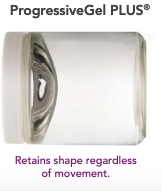
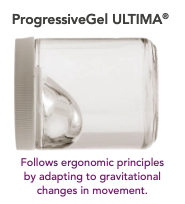
ProgressiveGel Plus is a firmer variant used in Motiva’s Round models for patients who want more defined upper-pole fullness.
Ergonomix
Motiva’s flagship adaptive implant model. It is designed to change shape with body position: settling into a teardrop shape when standing, spreading laterally when lying down, and following the body through everyday movements. It can be described as a “follows-you” effect. For patients comparing Motiva breast implants vs gummy bear implants, this adaptive behavior is often the most noticeable practical difference.
SmoothSilk Surface
Motiva’s nano-textured shell surface. It uses microscopic variations (measured at 3,500 to 4,500 nanometers) that are invisible to the naked eye. The surface is technically smooth but engineered to promote tissue integration without aggressive texturing.
Why it matters: Traditional anatomical gummy bear implants historically required textured shells to prevent rotation. That texturing has been linked to BIA-ALCL, a rare but serious lymphoma (more on this below). SmoothSilk was designed to provide the integration benefits of texture without the associated risks.
TrueMonobloc
A unified shell-and-gel construction method where the implant is built as a single piece rather than a shell filled separately with gel. This design allows the implant to stretch without rupturing during insertion, enabling surgeons to place it through incisions as small as 2.5 to 3 centimeters, compared to the roughly 4.5 to 5 centimeter incision typically needed for traditional gummy bear implants.
BluSeal
A visual barrier indicator built into the implant shell. If the shell is ever breached, the barrier changes color, making a rupture visible during imaging or surgical exploration. This is particularly relevant given that cohesive gel implants can experience “silent ruptures” (ruptures without obvious symptoms).
Q Inside / QID
A microchip embedded in the implant for identification and tracking. It stores information about the implant model, size, serial number, and manufacturer details. Think of it as a digital ID card for your implant.
For a deeper look at the materials and engineering behind Motiva, see our Motiva implant materials glossary.
Gummy Bear-Specific Terms
Anatomical (Teardrop) Implant
A gummy bear implant shaped to mimic the natural breast silhouette: narrower at the top, fuller at the bottom. Because it is not symmetrical, it must be oriented correctly during surgery and cannot rotate after placement. Historically, anatomical gummy bear implants required textured shells to grip surrounding tissue and prevent rotation.
Round Form-Stable Implant
A round gummy bear implant that eliminates rotation concerns because it looks the same from any angle. These can use smooth or textured shells and provide consistent upper-pole fullness.
Traditional Gummy Bear Manufacturers
Three companies have dominated the U.S. gummy bear implant market for over a decade:
Allergan Natrelle (now part of AbbVie), learn more about Natrelle breast implants
Mentor MemoryGel (Johnson & Johnson)
Sientra, learn more about Sientra breast implants
Motiva received FDA approval in September 2024, making it the first new breast implant approved since 2013, and a fourth option for U.S. patients.
Safety and Clinical Terms
Safety data is where the Motiva breast implants vs gummy bear comparison gets most interesting, and where precise terminology matters most.
Capsular Contracture
The most common breast implant complication. After any implant is placed, the body forms a capsule of scar tissue around it. In some cases, that capsule tightens and hardens, squeezing the implant, causing pain, distortion, or both. This is capsular contracture.
The numbers: Motiva’s FDA clinical trial showed a capsular contracture rate of 0.5% at three years. Traditional smooth silicone implants historically show rates of 5 to 15%.
Rupture Rate
The rate at which an implant’s shell fails. Motiva demonstrated a rupture rate of 0.6% at five years in its FDA trial.
Silent Rupture
A rupture that occurs without noticeable symptoms. Because cohesive gel holds together rather than leaking outward, the shell can breach without the patient feeling anything different. MRI screening is the standard method for detecting silent ruptures. Motiva’s BluSeal provides an additional visual indicator. For more on this topic, see our guide on Motiva breast implants and MRI safety.
BIA-ALCL (Breast Implant-Associated Anaplastic Large Cell Lymphoma)
A rare lymphoma that can develop in the scar tissue surrounding a breast implant. As of mid-2024, the FDA has recorded 64 deaths associated with BIA-ALCL, with risk estimates for textured implants ranging from 1 in 3,000 to 1 in 30,000 patients.
The critical point: The risk variable is surface texture, not the gel itself. Textured implants account for 73% of the 1,380 BIA-ALCL cases tracked by the FDA. Smooth-surfaced implants (including smooth gummy bear implants and Motiva’s SmoothSilk) carry no known increased risk. Motiva’s clinical trial reported zero cases of BIA-ALCL.
PMA (Premarket Approval)
The FDA’s most rigorous pathway for approving medical devices. Motiva’s PMA (P230005) was based on a clinical trial that tracked 800 patients across 32 U.S. centers for five years. At three years, compliance among the 451 primary augmentation participants was 92.4%, and patient satisfaction reached 97% at five years.
Reoperation Rate
The percentage of patients who undergo a second surgery related to their implants. Motiva’s primary augmentation reoperation rate was 6.1% at three years. What’s noteworthy is the shift in reasons: according to 3-year Motiva data, the leading causes of reoperation have moved away from complications like capsular contracture and rupture toward more subjective reasons such as malposition and size change.
FDA Post-Approval Study Requirement
As a condition of Motiva’s PMA approval, the FDA is requiring Establishment Labs to conduct a post-approval study following 2,400 patients for 10 years. The existing premarket cohorts must also be followed for 10 years. This is worth knowing because it means long-term safety data on Motiva will continue to accumulate. For a full breakdown of the current safety evidence, read our Motiva safety data glossary.
Exploring Motiva implants specifically? See how Dr. Mundra uses Motiva in her Denver practice.
Surgical and Placement Terms
Submuscular / Dual-Plane
Placement of the implant partially or fully beneath the pectoralis (chest) muscle. This is the most common approach for both Motiva and gummy bear implants. Dual-plane means the upper portion of the implant sits under the muscle while the lower portion sits under the breast gland only.
Subfascial
Placement under the fascia (a thin, tough layer of connective tissue) but above the pectoralis muscle. This approach is increasingly popular with Motiva implants because the softer gel and SmoothSilk surface are designed to work well without full muscular coverage. It avoids the animation deformity risk associated with submuscular placement.
Subglandular / Prepectoral
Placement above the muscle, directly behind the breast gland. Offers faster recovery and no animation deformity, but may show more visible implant edges in thin patients.
Animation Deformity
Visible distortion of the breast when the chest muscle contracts. This happens because submuscular implants sit underneath the pectoralis, so any flexion of that muscle pushes and deforms the implant. It is more common with submuscular placement regardless of implant type.
For patients considering over-the-muscle placement with Motiva, the softer gel and smooth surface may reduce some of the traditional concerns about prepectoral positioning.
Incision Length
Motiva implants can be inserted through incisions as small as 2.5 to 3 centimeters thanks to the TrueMonobloc design that allows compression without gel damage. Traditional gummy bear implants, because of their rigid form-stable structure, typically require incisions of 4.5 to 5 centimeters. The inability to compress a form-stable device restricts the use of minimally invasive insertion techniques.
Decision-Making Terms
Upper-Pole Fullness vs. Natural Drape
This is the fundamental aesthetic tradeoff when comparing Motiva breast implants vs gummy bear options.
Upper-pole fullness refers to volume and roundness in the top half of the breast. Gummy bear implants tend to maintain more consistent upper-pole fullness because their form-stable gel holds shape regardless of position.
Natural drape refers to the breast settling and moving with gravity the way natural tissue does. Motiva’s Ergonomix is explicitly designed for this, with the gel shifting and adapting as the body moves.
Neither is objectively better. It depends on what you want your results to look like during daily life, in different positions, and as you age.
Long-Term Aging Behavior
This is an underexplored but important consideration. As native breast tissue and skin lose elasticity over 10 to 15 years, they gradually droop and slide downward. A firm, form-stable gummy bear implant tends to stay high while the tissue descends around it, which can create an unnatural, visually disjointed appearance over time.
Motiva implants, designed with adaptive gel that behaves more like fluid biological tissue, tend to descend more harmoniously with the aging breast. For patients concerned about how their results will look a decade from now, this is a practical distinction worth discussing with your surgeon.
It is worth noting that some surgeons challenge the marketing claims around gummy bear implants more broadly. One contrarian perspective holds that the “natural look and feel, reduced risk of rupture, lower incidence of rippling, longevity, and reduced capsular contracture have not turned out to be confirmed in published studies” for traditional gummy bear formulations. This is a minority view, but it reinforces the importance of looking at actual clinical data rather than marketing language when making your decision.
Form-Stable vs. Adaptive
The simplest way to frame the design philosophy difference between traditional gummy bear implants and Motiva:
Form-stable implants hold a fixed shape. They resist deformation. They give predictable, consistent projection.
Adaptive implants change shape in response to body position and movement. They prioritize natural behavior over structural rigidity.
Tissue-Based Planning
Implant selection based on a patient’s actual anatomy (breast width, tissue thickness, chest wall shape, skin elasticity) rather than simply choosing a size or brand.
Who Is Each Best For?
After defining all these terms, the practical question remains: which type fits which patient?
Motiva Ergonomix tends to suit patients who:
Prioritize a soft, natural feel over structural firmness
Lead active lifestyles and want an implant that moves with their body
Are candidates for subfascial placement
Are particularly concerned about capsular contracture rates
Want the smallest possible incision
Traditional gummy bear implants tend to suit patients who:
Want reliable, consistent upper-pole fullness that does not change with position
Have very thin breast tissue and benefit from form stability to minimize rippling
Prefer a device with the longest domestic track record
Want a specific anatomical shape that remains fixed
Neither implant type is universally superior. The right choice depends on your anatomy, your aesthetic goals, and your surgeon’s expertise with the device. These are conversations that happen during a thorough, in-person evaluation.
Ready to discuss which implant fits your goals? Schedule a consultation with Dr. Leela Mundra in Denver.
Frequently Asked Questions
Are Motiva implants the same as gummy bear implants?
No. Motiva is a brand of silicone breast implant made by Establishment Labs. “Gummy bear” is a nickname for a type of firm, form-stable silicone gel used by several manufacturers including Allergan, Mentor, and Sientra. Motiva uses a softer, adaptive gel rather than the traditional form-stable formulation, so while both are silicone, they behave differently inside the body.
Which feels more natural, Motiva or gummy bear implants?
Most surgeons and patients report that Motiva’s ProgressiveGel feels softer and more like natural breast tissue compared to the firmer consistency of gummy bear implants. Gummy bear implants are designed to hold a fixed shape, which gives them a firmer feel by design.
Are gummy bear implants linked to cancer?
The BIA-ALCL concern is linked to textured implant surfaces, not to the cohesive gel itself. Smooth gummy bear implants carry no known increased BIA-ALCL risk. Historically, anatomical gummy bear implants used textured shells to prevent rotation, and it is those textured versions that are associated with the majority of BIA-ALCL cases.
How long has Motiva been FDA approved?
Motiva received FDA approval in September 2024 after a clinical trial that tracked 800 patients for five years. It was the first new breast implant approved in the U.S. since 2013. Outside the U.S., Motiva has been used for over 14 years in 85+ countries.
Is the smaller incision with Motiva a big advantage?
It can be. Motiva’s TrueMonobloc design allows insertion through incisions as small as 2.5 to 3 centimeters versus 4.5 to 5 centimeters for traditional gummy bear implants. A smaller incision generally means a shorter scar and potentially less tissue disruption, though the clinical significance depends on the individual patient and surgical approach.
Do gummy bear implants last longer than Motiva?
Gummy bear implants have a longer track record in the U.S., with expected longevity of about 20 years. Motiva’s 5-year data shows very low rupture rates (0.6%), and the FDA-mandated 10-year study will provide more definitive longevity information. It is too early to make a definitive head-to-head durability claim.
How do I decide between the two?
Start with your goals: Do you want consistent upper-pole fullness, or a soft, position-responsive result? Then discuss your anatomy with a plastic surgeon who has experience with both device types. The implant matters, but the surgeon’s skill and judgment matter more. Learn what to expect at a consultation to prepare for that conversation.