
Motiva Implants 2026: FDA Approval, Types & Safety

TL;DR
Motiva is a brand of silicone breast implant manufactured by Establishment Labs, a medical technology company founded in Costa Rica in 2004. In September 2024, Motiva received FDA approval for two implant models, marking the first new silicone breast implant approval in the United States since 2013. The implants are now available in over 85 countries, with nearly four million devices delivered worldwide. This guide defines every key term patients encounter when researching Motiva and provides honest context on safety data, technology, warranties, and how these implants compare to other brands.
Considering Motiva implants? Learn about our approach to breast augmentation.
Motiva: Definition and Background
Motiva is the brand name for a line of silicone gel breast implants made by Establishment Labs Holdings Inc. (NASDAQ: ESTA), a global medical technology company headquartered in Costa Rica. The company was founded in 2004, and Motiva implants have been commercially available since 2010.
The implants are produced at two FDA-compliant manufacturing facilities in Costa Rica and have been distributed in over 85 countries. To date, Establishment Labs has delivered nearly four million Motiva devices to plastic and reconstructive surgeons worldwide.
What separates Motiva from legacy implant brands is a combination of newer surface technology, dynamic gel formulations, and built-in identification features like RFID microchips. Whether these innovations translate to meaningfully better long-term outcomes than established competitors is a question the data is still answering, and that honesty matters.
The FDA Approval Milestone
In late September 2024, the FDA approved two Motiva implant models: the SmoothSilk Ergonomix and the SmoothSilk Round. This was granted through the Premarket Approval (PMA) pathway under PMA number P230005, the most rigorous regulatory pathway for medical devices.
This was significant for two reasons. First, it was the first PMA approval for a new silicone breast implant since 2013. Second, the clinical trial data showed notably low complication rates at the three-year mark: a capsular contracture rate of just 0.5% and a confirmed or suspected rupture rate of 0.6% among the 451 participants in the primary augmentation cohort.
The approval covers primary breast augmentation and revision augmentation for women aged 22 and older. Motiva implants for breast reconstruction are not yet commercially available in the U.S. and remain under clinical investigation.
FDA-Approved Motiva Implant Types
Two models are currently approved for use in the United States. Both feature Motiva’s SmoothSilk surface but differ in gel composition and behavior.
SmoothSilk Round
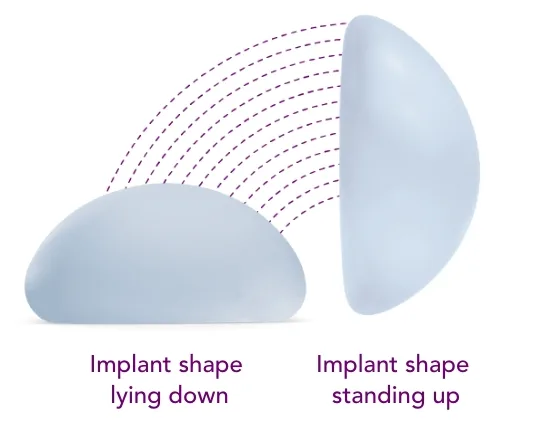
This model uses ProgressiveGel Plus, a firmer gel that maintains a round shape regardless of body position. It provides fuller cleavage and more projection. Patients who want a consistently round, voluminous look tend to gravitate toward this option.
SmoothSilk Ergonomix
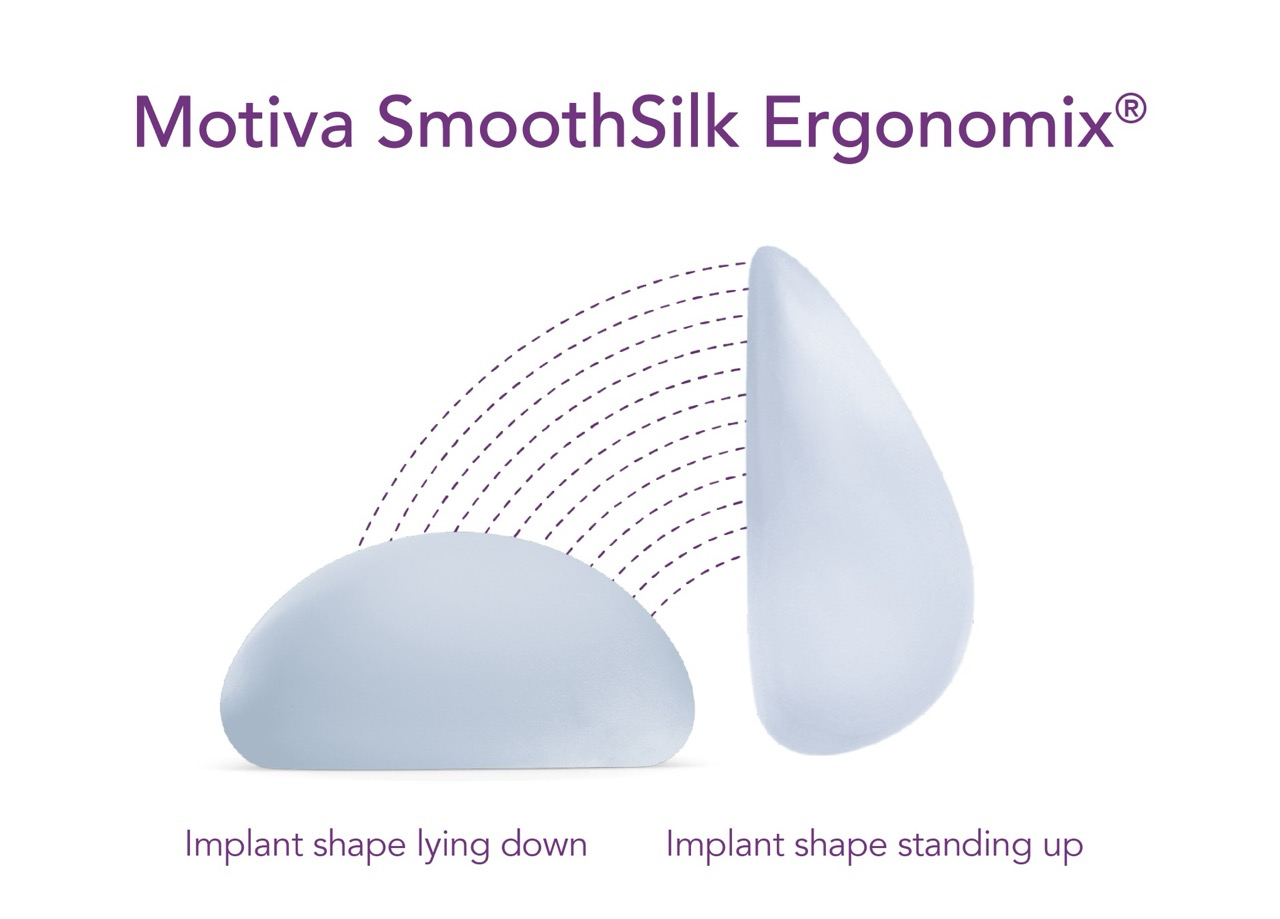
The Ergonomix model contains ProgressiveGel Ultima, a softer gel that responds to gravity and body movement. When you’re standing, the implant settles into a teardrop shape. When you’re lying down, it returns to a rounder profile. This dynamic behavior is what gives the Ergonomix its reputation for a more natural appearance, particularly during movement.
For a detailed breakdown of available profiles and volumes, see our guide on Motiva implant sizes and profiles.
Sizes and Projections
Motiva implants range from 105cc to 1050cc and come in three projection levels: Mini, Demi, and Full. This wide range means most body types and aesthetic goals can be accommodated without compromise.
Motiva Technology Glossary
One of the biggest challenges patients face when researching Motiva is the sheer number of proprietary terms. Here is what each one actually means and why it matters.
SmoothSilk Surface
SmoothSilk is Motiva’s nanotextured implant surface, engineered at the 4-micron level. Unlike the aggressive macro-texturing used by some older implants (which has been linked to complications), this ultra-fine surface aims to reduce friction against surrounding tissue, lower inflammatory response, and minimize bacterial attachment.
Why it matters: The surface of a breast implant plays a direct role in capsular contracture risk. Motiva’s SmoothSilk surface has not been associated with BIA-ALCL (breast implant-associated anaplastic large cell lymphoma), a rare cancer linked to certain textured implant surfaces. That distinction alone is a major reason surgeons and patients are paying attention.
ProgressiveGel (Plus vs. Ultima)
These are the two gel formulations used inside Motiva implants.
ProgressiveGel Plus is the firmer option. It holds a round shape consistently, providing more projection and fullness. Think of it as the gel for patients who want a clear, sculpted look.
ProgressiveGel Ultima is softer and more responsive. It allows the implant to change shape with body position, mimicking the movement of natural breast tissue. This is the gel inside the Ergonomix model.
For a closer look at what’s inside these implants and how the materials compare, our Motiva implant materials guide breaks it down further.
TrueMonobloc
Traditional breast implants are assembled from separate components: a shell, a patch (where the shell is sealed), and the gel filling. TrueMonobloc unifies these three elements into a single cohesive structure. The shell, patch, and gel are integrated rather than joined together as discrete parts.
Why it matters: This construction improves durability and allows surgeons to insert the implant through a smaller incision. It also reduces weak points in the shell that could be vulnerable to rupture over time.
BluSeal Safety Barrier
BluSeal is a thin blue indicator layer built into the implant’s shell. If the outer shell is compromised, the blue layer becomes visible, giving surgeons a quick visual confirmation of shell integrity during placement or revision surgery.
Why it matters: In traditional implants, a small shell defect might not be immediately obvious. BluSeal acts as a built-in quality check.
Q Inside Safety Technology (Qid)
This is perhaps the most distinctive Motiva technology. Each implant contains a tiny, passive RFID microchip, about the size of a grain of rice, encased in biocompatible glass. The chip stores the implant’s unique serial number, size, and model details. A surgeon can read this chip from outside the body using a handheld scanner.
The passive chip has no battery and uses technology that the FDA cleared for human implantation back in 2004.
Why it matters: Imagine you need a revision or MRI ten years from now, possibly with a different surgeon in a different city. Instead of relying on paper records or guesswork about what’s inside you, a doctor can scan the implant and get exact specifications instantly.
Ergonomix
Ergonomix is both a product name and a design philosophy. The Ergonomix implant uses ProgressiveGel Ultima to adapt its shape to gravity, holding a round profile when lying down and a teardrop when standing. For patients who prioritize natural movement and feel, Ergonomix is typically the recommended model.
Interested in learning how Motiva compares to other brands on feel and softness? That comparison is worth reading before a consultation.
Safety Terms Explained with Motiva Data
Understanding safety data requires knowing what the terms actually mean. Here are the most important ones.
Capsular Contracture
When any foreign object is placed in the body, the immune system forms a capsule of scar tissue around it. That’s normal. Capsular contracture happens when that scar tissue tightens excessively, squeezing the implant. It can cause pain, visible distortion, and firmness.
In Motiva’s FDA trial, the capsular contracture rate for Baker Grade III/IV (the grades severe enough to require intervention) was 0.5% at three years.
For a deeper look at the complete safety picture, our Motiva safety data guide covers the clinical trial results in detail.
Rupture
Rupture means the implant shell has broken or torn, allowing gel to escape. With modern cohesive silicone gel implants (including Motiva), the gel tends to stay in place even if the shell is compromised, which is very different from the liquid silicone of older generations.
Motiva’s confirmed or suspected rupture rate was 0.6% at three years.
Reoperation Rate
This refers to any additional surgery related to the implants after the initial procedure, whether for cosmetic revision, capsular contracture, rupture, asymmetry, or other reasons.
Motiva’s overall reoperation rate at five years was approximately 8.8%, compared to historical rates of 15-25% for other FDA-approved silicone implants. For patients considering revision breast augmentation, this lower reoperation rate is a relevant data point.
Baker Grade Scale (I through IV)
The Baker scale classifies capsular contracture severity:
Grade I: Breast looks and feels natural. Normal.
Grade II: Breast feels slightly firm but looks normal.
Grade III: Breast feels firm and looks abnormal (visible distortion).
Grade IV: Breast is hard, painful, and visibly distorted.
Grades III and IV typically require surgical intervention. When Motiva reports capsular contracture at 0.5%, they’re referring specifically to these higher grades.
BIA-ALCL
Breast Implant-Associated Anaplastic Large Cell Lymphoma is a rare type of cancer that develops in the scar tissue surrounding a breast implant. It has been primarily linked to macro-textured implant surfaces.
Motiva’s SmoothSilk microtextured surface has not been associated with any cases of BIA-ALCL. This is a meaningful safety distinction, and it is one of the reasons the brand gained traction internationally before entering the U.S. market.
PMA vs. 510(k) Approval
These are two different FDA approval pathways. A 510(k) clearance means a device is “substantially equivalent” to something already on the market. A PMA (Premarket Approval) requires the manufacturer to submit original clinical trial data proving safety and effectiveness. PMA is a higher bar.
Motiva’s implants went through the PMA pathway, which is why the process took years and involved a multi-center clinical trial with hundreds of participants.
Preservé by Motiva

Preservé is not an implant. It is a surgical technique developed in conjunction with Motiva that emphasizes smaller implants, a smaller incision, careful pocket creation, and placement of the implant above the muscle (subglandular). The method focuses on preserving the breast’s natural tissues and support structures rather than aggressively cutting or releasing tissue.
The approach works with a patient’s existing anatomy to achieve natural-looking results and aims for a smoother recovery.
Preservé requires careful patient selection. It works best for patients with adequate natural breast tissue to provide coverage over the implant. It is not appropriate for everyone.
Interested in this approach? Learn more about Preservé by Motiva and schedule a consultation with Dr. Leela Mundra, a Harvard-trained plastic surgeon and exclusive provider of this approach in Denver.
Warranty Terms
All Motiva implants sold in the United States come with structured warranty coverage. Understanding these terms before surgery matters, because warranty protections have specific conditions and timelines.
Always Confident Warranty
This provides lifetime coverage against implant rupture. If a Motiva implant ruptures at any point, the replacement device is covered.
Product Replacement Policy
Covers capsular contracture (Baker Grades III and IV) for a period of 10 years after implantation. If a patient develops clinically significant contracture within that window, the implant is replaced.
Extended Warranty Programs
Motiva offers optional extended warranty coverage. The 5-Year Extended Warranty covers up to $2,500 applicable toward revision surgery expenses in the event of capsular contracture or rupture. There is also a 2-Year Extended Warranty option.
One detail patients often overlook: implants must be registered within 90 days of surgery to activate warranty coverage. This is something to confirm with your surgeon’s office immediately after the procedure.
How Motiva Compares to Other Implant Brands
The four major breast implant brands available in the United States are Motiva, Allergan (Natrelle), Mentor, and Sientra. Here is a factual comparison of key data points.
Metric | Motiva (3-5 yr data) | Allergan Natrelle (10 yr) |
|---|---|---|
Capsular contracture (Baker III/IV) | 0.5% at 3 yr | ~18.9% at 10yr |
Rupture | 0.6% at 3 yr | Varies by model |
Reoperation | ~8.8% at 5 yr | 15-25% historical |
Patient satisfaction | 97% at 5 yr | Not directly comparable |
BIA-ALCL association | None reported | Linked to textured models |
RFID identification | Yes (Q Inside) | No |
For detailed comparisons, see our guides on Motiva vs. Sientra and Motiva vs. Natrelle.
The Data Fairness Caveat
This point cannot be overstated: Motiva has 3 to 5 years of published follow-up data while Allergan and Mentor have 10-year studies. Longer studies will always show higher cumulative complication rates. Motiva’s numbers look exceptional right now, and they may hold up beautifully at 10 years, but that data simply does not exist yet. Any page telling you Motiva is definitively “better” than legacy brands without this caveat is not giving you the full picture.
Ideal Candidates for Motiva
Motiva implants are commonly recommended for several patient profiles:
Patients pursuing a natural-looking result (sometimes called the “ballerina breast” aesthetic)
Women particularly concerned about capsular contracture risk
Active patients and athletes who want an implant that moves naturally with their body
Patients interested in less invasive surgical techniques like Preservé
Women seeking their first augmentation as well as those considering implant exchange
Motiva implants carry an expected lifespan of 10 to 20 years, which is among the longest in the industry. Like all breast implants, they are not lifetime devices and will likely need replacement at some point.
Ready to discuss which implant is right for your anatomy and goals? Schedule a consultation.
Frequently Asked Questions
Are Motiva implants FDA approved?
Yes. In September 2024, the FDA granted PMA approval (P230005) for two Motiva models: the SmoothSilk Round and SmoothSilk Ergonomix. This was the first new silicone breast implant approval in the United States since 2013. The approval covers primary and revision breast augmentation for women aged 22 and older.
What is the difference between Motiva Round and Ergonomix?
The Round model uses a firmer gel (ProgressiveGel Plus) that maintains a round shape in all positions, providing more projection and fullness. The Ergonomix uses a softer gel (ProgressiveGel Ultima) that shifts between a round and teardrop shape depending on body position, creating a more natural look and feel during movement.
How long do Motiva implants last?
Motiva implants have an expected lifespan of 10 to 20 years. They are not considered lifetime devices. The Always Confident Warranty covers rupture for the lifetime of the device, and the Product Replacement Policy covers capsular contracture for 10 years.
What does the RFID chip in Motiva implants do?
The Q Inside chip is a passive RFID microchip (no battery, encased in biocompatible glass) that stores the implant’s serial number, size, and model information. A surgeon can scan it through the skin with a handheld device to identify the implant without imaging or records, which is especially useful years later if a patient sees a different doctor.
Has Motiva been linked to BIA-ALCL?
No. Motiva’s SmoothSilk nanotextured surface has not been associated with any reported cases of BIA-ALCL. This rare cancer has been primarily linked to macro-textured implant surfaces, which Motiva does not use.
Is Motiva safer than Allergan or Mentor?
Motiva’s early data shows lower complication rates, but a direct comparison is not straightforward. Motiva’s published data covers 3 to 5 years, while Allergan and Mentor have 10-year studies. Complication rates accumulate over time, so the shorter study window naturally produces lower numbers. Motiva’s results are very promising, but equivalent long-term data will take several more years to develop.
What is Preservé by Motiva?
Preservé is a surgical technique (not an implant) that emphasizes tissue preservation, smaller incisions, and above-the-muscle implant placement. It is designed for use with Motiva Ergonomix implants and aims for a less invasive approach with smoother recovery. It is not appropriate for every patient and requires adequate natural breast tissue for proper implant coverage.
Learn what to expect during a consultation and take the next step toward informed, confident decision-making.