
Motiva Implants Material: 2026 Guide to What’s Inside
TL;DR
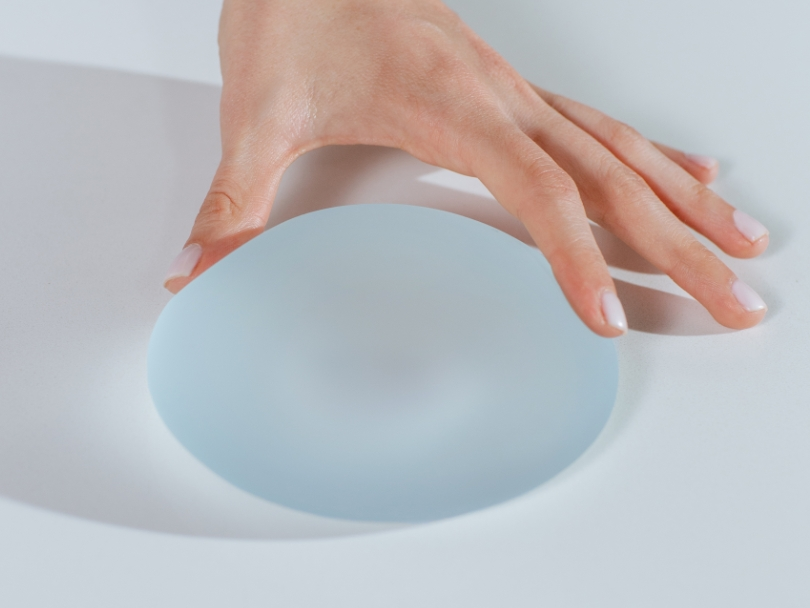
Motiva breast implants are made from medical-grade silicone sourced from the same supplier used across the industry. What sets them apart is how that silicone is engineered: a proprietary cohesive gel fill (ProgressiveGel), a nanosurface shell (SmoothSilk), seamless shell-gel bonding (TrueMonobloc), a visible barrier layer (BluSeal), and an embedded RFID chip for identification. This glossary breaks down each material component so you can have a more informed conversation with your surgeon.
Motiva uses a lot of proprietary terminology to describe what goes into its breast implants. ProgressiveGel, SmoothSilk, TrueMonobloc, BluSeal. These names sound impressive, but what do they actually mean? And how do they differ from what’s inside implants made by Allergan, Mentor, or Sientra?
This glossary explains every Motiva implants material in plain language, covers what the clinical data shows, and flags the nuances that most marketing pages leave out.
Explore Motiva implants to see how these materials factor into the augmentation options offered at our Denver practice.
The Base Material: Medical-Grade Silicone
Here’s the most common misconception about Motiva: that it’s made from something other than silicone. It’s not. Motiva implants are silicone breast implants. The fill is silicone gel, and the shell is silicone elastomer.
According to the FDA’s Summary of Safety and Effectiveness Data, Motiva’s Round and Ergonomix implants use a single-lumen silicone elastomer shell with a silicone gel filler. The shell is built from successive cross-linked layers of silicone elastomer with a low-diffusion barrier layer.
What distinguishes Motiva implants material from other brands is how Establishment Labs (the manufacturer, based in Costa Rica) formulates, layers, and bonds that silicone.
Think of it like flour. Every bakery buys flour. The bread still tastes different depending on how the baker handles it.
ProgressiveGel: The Fill
ProgressiveGel is the name Motiva gives to its silicone gel filling. It comes in two formulations, each designed for a different implant style.
ProgressiveGel Plus (Round Implants)
This is a cohesive silicone gel engineered for a fuller, more projected look, particularly in the upper pole of the breast. It’s the fill used in Motiva’s Round implants.
ProgressiveGel Ultima (Ergonomix Implants)
ProgressiveGel Ultima is classified as a sixth-generation cohesive silicone gel with low viscosity and high elasticity. In practical terms, that means it moves with your body. When you stand up, the gel settles naturally. When you lie down, it redistributes. This is the fill used in Motiva’s Ergonomix line, which is designed to mimic the shape changes of natural breast tissue.
Why This Matters
Laboratory testing shows that Motiva’s gel maintains 100% cohesivity even when the shell is cut. The gel stays together as a single mass rather than leaking out. This is a meaningful safety feature: even if the shell were compromised, the gel remains contained. The gel’s lower density compared to traditional silicone also contributes to a softer, more natural feel.
For a deeper look at how implant profiles and sizes pair with these gel types, see our guide to Motiva implant profiles and sizes.
SmoothSilk / SilkSurface: The Outer Shell Surface
The outside of every breast implant has a surface texture that interacts with your body’s tissue. Historically, implants came in two options: smooth or textured. Textured surfaces were designed to reduce the risk of the implant rotating or shifting, but they were later linked to BIA-ALCL (breast implant-associated anaplastic large cell lymphoma), a rare cancer of the immune system. Allergan’s BIOCELL textured surface was recalled from the market for this reason.
Motiva’s SmoothSilk technology sits in a different category. Created using 3D nanotechnology, the surface measures just 3.2 micrometers (µm) of roughness. For context, smooth implants are classified as having less than 10 µm of texturization, microtextured surfaces fall between 10 and 50 µm, and macrotextured surfaces exceed 50 µm.
So technically, SmoothSilk falls within the “smooth” classification. Motiva markets it as a nanotextured sweet spot that reduces friction and minimizes inflammatory response.
What the Research Shows
In a 2023 meta-analysis of 4,784 patients, zero cases of BIA-ALCL were reported with Motiva’s SmoothSilk surface.
TrueMonobloc: Shell Construction
Most breast implants are assembled in layers: a shell is formed, a patch seals the fill hole, and the gel sits inside. The shell and gel are separate components. In conventional implants, the gel can shift independently of the shell, which some surgeons describe as the silicone “sloshing around” inside.
TrueMonobloc is Motiva’s proprietary approach to bonding the shell, patch, and gel into a single unified structure. No seams, no separate components. The implant moves as one piece.
How It Works
The number of times the mandrel (the mold) is dipped into silicone to form the shell varies between Motiva’s Round and Ergonomix lines. The Ergonomix shell gets fewer dips, giving it greater elasticity to match the softer, more elastic ProgressiveGel Ultima inside it. Because the shell and gel elasticities are calibrated to each other, the implant moves as a complete unit rather than having its internal gel shift independently.
Practical Benefits
This unified construction contributes to durability. Because the implant can flex without internal stress points, it can also be compressed through a smaller incision during surgery. Smaller incision means smaller scars, which matters to most patients.
BluSeal: The Barrier Layer
BluSeal is a biocompatible barrier layer built into the implant shell. Its job is twofold.
First, it acts as a gel diffusion barrier. All silicone breast implants allow microscopic amounts of silicone to “bleed” through the shell over time. BluSeal is designed to minimize this. In the unlikely event of a shell breach, the barrier helps keep the gel contained.
Second, it’s tinted blue. The pigment (which represents less than 0.05% of the barrier layer material) allows the surgeon to visually confirm the barrier layer is intact before placing the implant. According to the FDA’s review, all implants in the U.S. pivotal study contained this pigmented barrier layer.
It’s a simple quality control feature, but it gives both surgeon and patient an extra layer of confidence during the procedure.
Q Inside Safety Technology: The RFID Chip
Q Inside is an FDA-cleared RFID microchip embedded inside the implant. It allows for non-invasive identification of the implant’s serial number, size, type, and manufacturing details at any point after surgery.
Why does this matter? Breast implants are not lifetime devices. At some point, whether years or decades later, you or a future surgeon may need to know exactly what’s inside you. The chip eliminates guesswork. A handheld scanner reads the implant information through the skin without imaging or surgery.
No other major implant brand offers this. Allergan, Mentor, and Sientra rely on paper records and patient cards, which can be lost.
For more on tracking and long-term implant management, browse our patient education videos.
How Motiva Materials Compare to Other Implant Brands
One of the most useful ways to understand Motiva implants material is to see it side by side with competitors.
Feature | Motiva | Allergan Natrelle | Mentor | Sientra |
|---|---|---|---|---|
Fill | ProgressiveGel (Plus or Ultima) | TruForm gels (1, 2, 3) | MemoryGel / Cohesive I-III | High Strength Cohesive / HSC+ |
Shell Surface | SmoothSilk (3.2 µm nanosurface) | Smooth or BIOCELL textured | Smooth or Siltex microtextured | Smooth or textured |
Shell Construction | TrueMonobloc (shell + gel bonded) | Standard layered | Standard layered | Standard layered |
Barrier Layer | BluSeal (visible blue indicator) | IntraShield | Standard barrier | Standard barrier |
Safety Tech | RFID chip (Q Inside) | None | None | None |
The key material differentiator is TrueMonobloc. Only Motiva bonds the gel and shell into one unit. All three competitors use standard layered construction where the gel and shell move independently.
On the fill side, Sientra is known for its firm, high-strength cohesive gel, while Motiva’s ProgressiveGel emphasizes softness and dynamic movement. Allergan’s TruForm gels offer a range of cohesivity levels but don’t match Motiva’s rheological profile according to independent practitioner analysis.
For detailed brand comparisons, see our articles on Motiva vs. Allergan and Motiva vs. Sientra.
What the Clinical Data Says About These Materials
Motiva received FDA premarket approval (PMA) in September 2024, the first PMA for a new silicone breast implant since 2013. That approval was based on a U.S. pivotal study that tracked outcomes over three years.
Key findings from the clinical trial:
Less than 1% incidence of capsular contracture at three years for primary augmentations
Less than 1% rupture rate at three years
The leading cause of revision surgery shifted from capsular contracture and rupture to more subjective reasons like size change and malposition
From the 2023 meta-analysis (4,784 patients):
Overall complication rate of 5.2%
Capsular contracture in approximately 0.5% of cases
Zero reported cases of BIA-ALCL
These numbers are favorable compared to some traditional implants, which can see capsular contracture rates closer to 10% or more over time. But context matters: Motiva’s data covers short-to-mid-term follow-up. Long-term data (10+ years) is still being collected.
Breast implants interact with the body over decades, and material performance at year three doesn’t guarantee the same performance at year fifteen.
If you’re considering how these materials hold up over time and what happens when implants eventually need replacing, our page on implant exchange covers that process in detail.
Frequently Asked Questions
Are Motiva implants silicone?
Yes. ProgressiveGel is a silicone gel formulation. The shell is silicone elastomer. Motiva implants are not an alternative to silicone. They are silicone, engineered differently than traditional options.
What makes Motiva’s silicone different from other brands?
The raw silicone comes from the same supplier used across the industry. The difference is in formulation ratios, shell construction (TrueMonobloc bonding), and surface engineering (SmoothSilk nanosurface). Same base ingredient, different recipe.
Do Motiva materials reduce BIA-ALCL risk?
No cases of BIA-ALCL have been reported with Motiva implants to date. The SmoothSilk surface is classified within the smooth category (3.2 µm), and BIA-ALCL has been primarily associated with macrotextured surfaces. However, long-term surveillance data is still maturing, and no controlled studies have directly compared Motiva’s surface to traditional smooth implants for this outcome.
How long do Motiva implants last?
Breast implants are not lifetime devices, regardless of brand. Motiva’s materials are designed for durability, and the three-year clinical data shows low rupture rates. But at some point, most patients will need a revision or exchange. The timeline varies by individual.
What is the RFID chip made of, and is it safe?
Q Inside uses an FDA-cleared biocompatible RFID microchip encased within the implant. It’s passive (no battery, no signal emission) and only activates when scanned with a specific reader.
Is the blue tint from BluSeal visible through the skin?
No. The pigment represents less than 0.05% of the barrier layer material. It’s visible to the surgeon during placement but not through breast tissue after implantation.
Can I get an MRI with Motiva implants?
Motiva implants are MR-conditional, meaning MRI is safe under specified conditions. For more detail, see our article on Motiva implants and MRI safety.
Understanding the materials inside your implants is one part of making a confident decision. The other part is working with a surgeon who can explain how those materials translate to your specific anatomy and goals.
Schedule a consultation with Dr. Mundra to discuss which implant materials are the best fit for the results you’re looking for.