
Motiva Implants vs Allergan 2026: Safety, Feel, Cost

TL;DR
Motiva and Allergan (Natrelle) are two of the four FDA-approved silicone breast implant brands available in the U.S. Motiva is the newest option, FDA approved in September 2024, with standout early safety data including a 0.5% capsular contracture rate at three years and zero reported cases of BIA-ALCL worldwide. Allergan’s Natrelle Inspira smooth implants remain a trusted choice backed by decades of long-term clinical data. The right implant depends on your anatomy, aesthetic goals, and your surgeon’s expertise.
Why This Comparison Matters
Four silicone breast implant manufacturers currently hold FDA approval in the United States: Motiva, Allergan (Natrelle), Mentor, and Sientra. If you’re researching breast augmentation, you’ve probably already encountered the Motiva implants vs Allergan debate.
The reason is timing. Motiva received FDA approval in September 2024, making it the first new breast implant approved in the U.S. since 2013. Allergan’s Natrelle line, by contrast, has been available for decades.
Understanding the terminology each company uses is half the battle. Implant marketing is full of branded terms (SmoothSilk, TruForm, ProgressiveGel, ConfidencePlus) that can obscure what actually matters: safety, feel, durability, and how each option fits your body. This glossary breaks down every important term and connects it to the decision you’re actually trying to make.
Explore breast augmentation options to see how implant selection fits into a personalized surgical plan.
Motiva Brand Glossary
Motiva (Establishment Labs)
Motiva is manufactured by Establishment Labs, a medical device company headquartered in Costa Rica. Before entering the U.S. market, the brand built a substantial international track record: over 14 years of use across 86 countries, with nearly 4 million devices placed globally. Since FDA approval, more than 60,000 Motiva implants have been sold in the United States.
Motiva Ergonomix
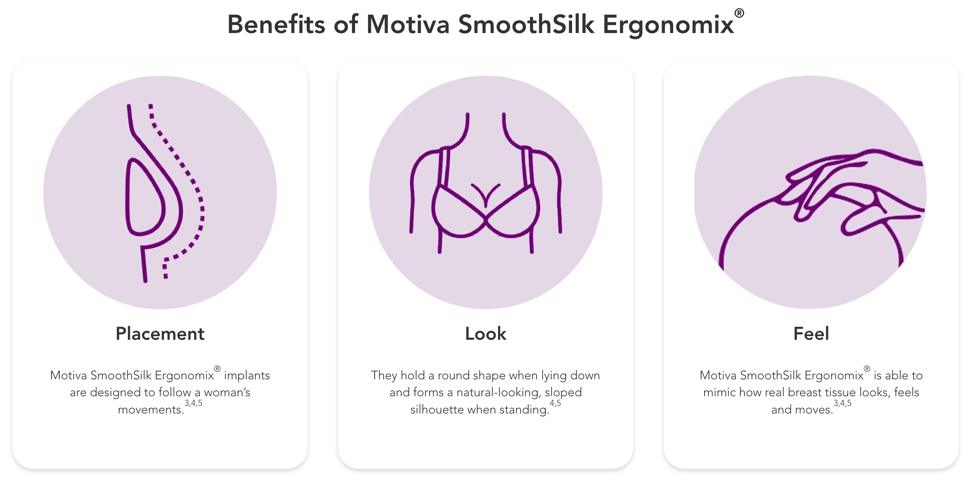
The Ergonomix is Motiva’s flagship implant and the one generating a lot of interest. It uses a softer, adaptive gel that responds to gravity and body position. When you’re standing, the gel shifts into a more teardrop shape. When you’re lying down, it rounds out. This is the behavior patients describe when they say Motiva implants “feel like natural breast tissue.”
This dynamic movement is fundamentally different from traditional round implants, which maintain the same shape regardless of position. The Ergonomix is designed for patients who prioritize a natural look and soft feel over maximum upper-pole fullness. You can see the full range of Motiva profiles and sizes to understand the options available.
Motiva SmoothSilk Round
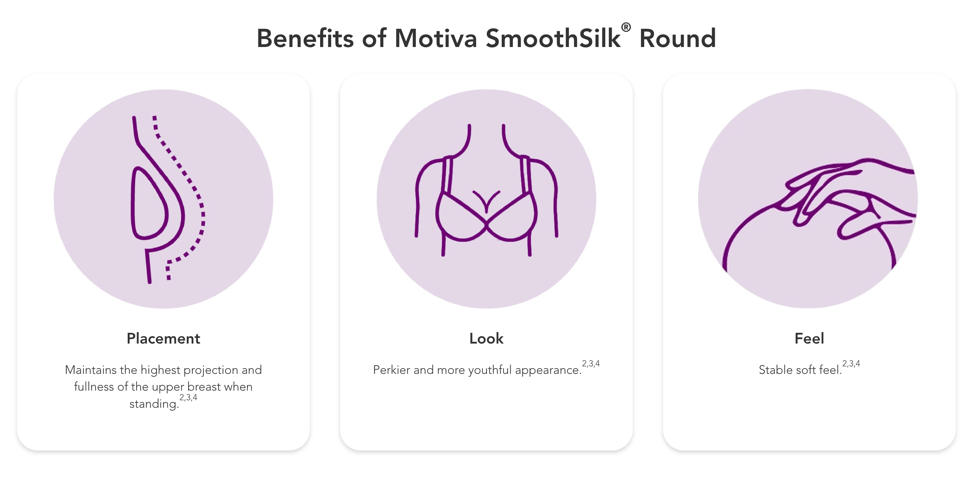
Motiva’s second FDA-approved implant type. The SmoothSilk Round uses a firmer gel (called ProgressiveGel Ultima) that provides more consistent projection and upper-pole fullness. It shares the same SmoothSilk shell surface as the Ergonomix but delivers a different aesthetic result: more “augmented” looking, which some patients prefer.
SmoothSilk Surface
This is the shell technology, and it may be the single most important differentiator in the Motiva implants vs Allergan comparison.
Traditional breast implants use either smooth or textured shells. Textured surfaces were designed to reduce capsular contracture (more on that below), but they came with a serious trade-off: a strong association with BIA-ALCL, a rare cancer. Motiva’s SmoothSilk is a nanosurface, meaning it has a microscopic texture that’s functionally smooth. It’s engineered to reduce the inflammatory response that triggers capsular contracture without the risks associated with macro-textured surfaces.
The clinical data supports this approach. In Motiva’s FDA trial of 451 primary augmentation patients, the capsular contracture rate was just 0.5% at three years. There have been zero reported cases of BIA-ALCL with Motiva implants worldwide.
ProgressiveGel and ProgressiveGel Ultima
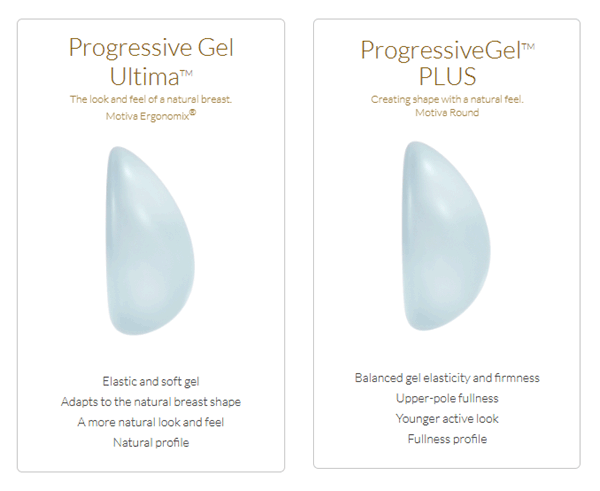
These are the two gel formulations inside Motiva implants. ProgressiveGel is the softer version used in the Ergonomix. ProgressiveGel Ultima is the firmer version used in the SmoothSilk Round. The names aren’t just marketing. Practitioners who’ve worked extensively with both report that the gel characteristics of Motiva implants are essentially a mirror image of traditional implant gels: they score highest on the properties surgeons want (softness, elasticity, natural movement) and lowest on the properties surgeons want to avoid (excessive firmness, resistance to compression).
TrueMonobloc
In most traditional implants, the silicone gel and the outer shell have different elasticity levels. This means the gel can move somewhat independently inside the shell, which some surgeons describe as a “sloshing” sensation. Motiva’s TrueMonobloc design matches the elasticity of the shell and gel so the implant moves as a single, unified unit. The practical benefit is more natural movement and a reduced likelihood of gel wrinkling or folding inside the shell.
BluSeal
A blue-colored barrier layer built into the inner surface of the implant shell. If the outer shell is ever compromised, the blue layer becomes visible during examination, giving surgeons an early visual indicator of a potential breach. Think of it as an extra safety checkpoint during routine monitoring.
Q Inside Safety Technology
An RFID microchip embedded in the implant that stores the device’s serial number and specifications. This allows for quick identification of implant details without imaging. Important caveat: this feature is not currently available in the U.S. It’s used internationally but has not received FDA clearance for the American market.
Motiva Health Program (Warranty)
Motiva’s warranty, called the Always Confident Warranty (part of the broader Motiva Health Program), includes lifetime coverage for rupture due to manufacturing defects, with free replacement implants. It also provides 10-year protection against moderate to severe capsular contracture (Baker Grades III and IV).
One standout feature: the Motiva Health Program Plus includes an explant credit of up to $2,500 within two years of surgery if you decide implants aren’t right for you. An upgraded warranty is available for $250 per the manufacturer. This explant credit is unusual in the industry and reflects confidence in the product, though it also acknowledges that not every patient will be satisfied long-term.
Allergan (Natrelle) Brand Glossary
Allergan / AbbVie Aesthetics
Allergan is one of the most recognized names in aesthetic medicine, now operating under AbbVie’s Medical Aesthetics division. The company has manufactured breast implants for decades and offers one of the broadest product lines in the industry. When people compare Motiva implants vs Allergan, they’re almost always referring to Allergan’s Natrelle line.
For a deeper look at the full Natrelle product range, see Natrelle breast implants.
Natrelle Inspira
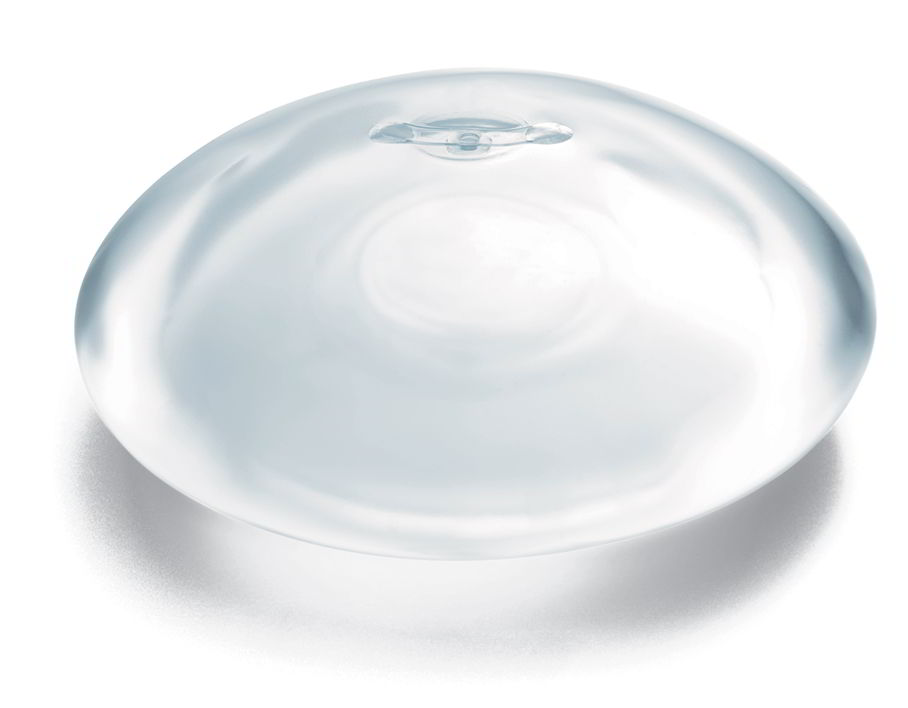
The Inspira is Allergan’s current workhorse for cosmetic breast augmentation in the U.S. These are smooth, round, cohesive silicone gel implants available in a wide range of sizes and profiles. What makes the Inspira line versatile is its gel system, TruForm, which comes in three cohesiveness levels.
TruForm Gel (Levels 1, 2, and 3)
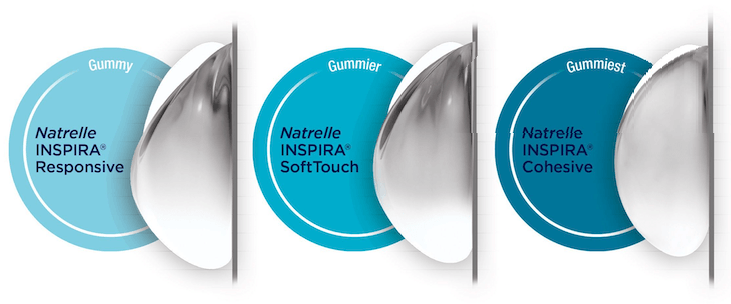
TruForm is Allergan’s branded gel technology. The three levels represent different degrees of firmness:
TruForm 1: Softest. More natural feel, less projection. Best for patients with adequate breast tissue who want subtle results.
TruForm 2: Medium cohesivity. The most commonly selected option, balancing feel with shape retention.
TruForm 3: Firmest. Holds its shape most consistently. Suited for patients wanting maximum projection or those with thinner tissue who need more structural support to minimize rippling.
This tiered system gives surgeons considerable flexibility, which is one of Allergan’s genuine strengths. The Inspira range has been supported by large, long-term clinical studies spanning 10 years or more.
Natrelle 410 (Historical)
The Natrelle 410 was Allergan’s anatomically shaped “gummy bear” implant. It used a highly cohesive gel that maintained a teardrop shape. However, it required a textured surface (Biocell) to prevent rotation inside the pocket. Following the 2019 recall, the 410 is no longer available in the U.S.
ConfidencePlus Warranty
When you receive Natrelle implants, you’re automatically enrolled in Allergan’s ConfidencePlus Warranty Program. The standard program offers 10 years of financial assistance, including up to $3,500 to cover out-of-pocket expenses related to qualifying complications. Most patients can upgrade to the Premier tier for a one-time fee of $100, which increases the coverage amounts.
Key Comparison Terms
Capsular Contracture
What it is: Every breast implant triggers the body to form a thin layer of scar tissue around it, called a capsule. This is normal. Capsular contracture happens when that capsule tightens and hardens, squeezing the implant.
Why it matters in this comparison: Capsular contracture rates are the sharpest statistical difference between Motiva and traditional implants.
Motiva’s FDA trial showed a 0.5% rate at three years. By comparison, published 10-year rates for other silicone implant manufacturers (including Allergan, Mentor, and Sientra) range from 15.8% to 36.9% for advanced capsular contracture.
The important caveat: Motiva’s data covers 3 years. Allergan’s covers 10. The FDA has mandated a 10-year post-approval study of approximately 2,400 women to monitor Motiva’s long-term outcomes. Until that data matures, the comparison involves different time horizons.
If you’re dealing with capsular contracture from existing implants, implant exchange may be a path worth exploring.
BIA-ALCL (Breast Implant-Associated Anaplastic Large Cell Lymphoma)
A rare cancer of the immune system, not breast cancer itself, that develops in the scar tissue and fluid surrounding a breast implant. It is most strongly associated with macro-textured implant surfaces.
Motiva: Zero reported cases worldwide across nearly 4 million implants placed.
Allergan: The recalled Biocell textured surface was linked to the majority of known cases. Allergan’s current smooth implants have not been associated with BIA-ALCL at elevated rates.
This is why surface technology matters so much in the Motiva implants vs Allergan discussion. The risk is tied to the surface, not the brand broadly.
Rupture Rate
What it is: A break or tear in the implant shell. Modern silicone implants use cohesive gel that stays in place even if the shell ruptures (called a “silent rupture”), unlike older liquid silicone that could migrate.
Motiva: 0.6% confirmed or suspected rupture at 3 years in the FDA trial.
Traditional silicone implants: Low single digits at 10 years across manufacturers.
Both numbers are low. Rupture alone is rarely the deciding factor between brands, though Motiva’s BluSeal technology offers an additional detection layer.
Rippling
Visible wrinkling or folding of the implant that shows through the skin. This tends to happen more in patients with thin breast tissue or low body fat.
Bottoming Out and Malposition
Bottoming out means the implant drops below its intended position, making the nipple appear to sit too high on the breast. Malposition more broadly refers to the implant shifting from where the surgeon placed it, including lateralization (drifting toward the armpit).
This is where techniques like the internal bra become relevant, providing additional support.
Side-by-Side Quick-Reference Table
Feature | Motiva | Allergan (Natrelle) |
|---|---|---|
Manufacturer | Establishment Labs (Costa Rica) | Allergan / AbbVie Aesthetics |
FDA Approval | September 2024 | Decades of U.S. approval history |
Available Types | Ergonomix, SmoothSilk Round | Inspira (smooth round), various profiles |
Gel Technology | ProgressiveGel (soft), ProgressiveGel Ultima (firmer) | TruForm 1, 2, 3 (soft to firm) |
Shell Surface | SmoothSilk nanosurface | Smooth (current); Biocell textured (recalled 2019) |
Capsular Contracture Rate | 0.5% at 3 years | 15.8%–36.9% at 10 years (historical, all manufacturers) |
Rupture Rate | 0.6% at 3 years | Low single digits at 10 years |
BIA-ALCL Cases | Zero worldwide | Linked to recalled Biocell textured surface; smooth implants not elevated |
Warranty | Lifetime rupture replacement; 10-yr contracture coverage; up to $2,500 explant credit | 10-yr ConfidencePlus (up to $3,500); Premier upgrade for ~$100 |
Long-Term Data | 3-year FDA trial; 10-year study in progress | 10+ year clinical studies available |
FDA-Approved Uses | Augmentation only | Augmentation and reconstruction |
What the Data Doesn’t Tell You Yet
Honest coverage of Motiva implants vs Allergan requires acknowledging what we don’t know.
Most published Motiva data comes from international markets where textured implant usage is more common and surgical techniques differ from U.S. norms. Some complication patterns reported overseas may not translate directly to American practice.
The 3-year vs. 10-year data gap is real. Motiva’s early numbers are exceptional, but breast implants live in the body for decades. The FDA-mandated 10-year post-approval study will be the true test. Allergan’s long track record is not just a marketing talking point; it represents clinical evidence accumulated over thousands of patients observed across a meaningful time horizon.
A large meta-analysis of nearly 5,000 Motiva patients found an overall complication rate of just 5.2%, meaning roughly 95% experienced no complications. That’s encouraging, but the study population skews toward shorter follow-up periods.
Which Implant Is Right for You?
No article can answer this question for you. What an article can do is help you ask better questions during your consultation.
Motiva’s strengths are clearest for patients who prioritize natural feel, want the lowest available capsular contracture risk, and are comfortable with a newer product that has excellent short-term data but limited long-term evidence. The Ergonomix, in particular, offers a dynamic, gravity-responsive feel that traditional round implants don’t replicate.
Allergan’s strengths are clearest for patients who value decades of clinical history, need the broadest possible selection of sizes and profiles. The TruForm gel system gives surgeons fine-tuned control over firmness and projection.
Both brands produce excellent results in the right hands. And that last phrase is the one that matters most. A Motiva implant will not compensate for poor implant selection or improperly created pockets, and the same is true for Allergan. Surgeon skill, experience, and judgment are more important than the brand name on the box.
RealSelf currently features 483 Motiva reviews with a 96% “Worth It” rating. Patients consistently highlight natural feel, softer results, and reduced recovery time. Allergan’s smooth implants similarly enjoy strong satisfaction numbers built over a much longer period.
The only way to determine the best option for your body is a personalized consultation that accounts for your tissue thickness, chest measurements, aesthetic goals, and lifestyle.
Schedule a consultation to discuss which implant option fits your anatomy and goals.
Frequently Asked Questions
Are Motiva implants FDA approved?
Yes. Motiva received FDA premarket approval in September 2024, making it the first new breast implant approved in the U.S. since 2013. Two types are currently available: the Ergonomix and the SmoothSilk Round. Approval is limited to augmentation; Motiva is not yet approved for breast reconstruction in the U.S.
Did Allergan recall all their breast implants?
No. The 2019 recall applied only to Allergan’s Biocell textured breast implants and tissue expanders, which were linked to BIA-ALCL. Allergan’s smooth and Microcell implants were not affected. The current Natrelle Inspira line sold in the U.S. is smooth-shell only and remains widely used.
Which implant feels more natural?
Most practitioners and patients report that Motiva’s Ergonomix feels softer and more natural than traditional cohesive gel implants. Its ProgressiveGel adapts to body position and movement. Allergan’s TruForm 1 (softest tier) is the closest Natrelle equivalent in terms of softness, though the gel physics differ. If natural feel is your top priority, the Ergonomix is generally the stronger choice, but tissue thickness and placement (over or under the muscle) also play a significant role. Learn more about over-the-muscle placement and how it affects feel.
How long do Motiva vs. Allergan implants last?
Neither implant is a lifetime device. The FDA does not assign an expiration date to breast implants, but complications and changes in preference mean most patients will eventually need a reoperation. Motiva’s current data extends to three years with strong results, and a 10-year study is underway. Allergan has published 10-year data showing that while implants can last well beyond a decade, complication rates (particularly capsular contracture) increase over time.
What is the difference between smooth and textured implants?
Smooth implants have a uniform, non-grippy outer shell. Textured implants have a roughened surface designed to adhere to surrounding tissue and reduce movement. The key issue: macro-textured surfaces (particularly Allergan’s Biocell) were linked to BIA-ALCL, leading to the 2019 recall. Motiva’s SmoothSilk is a nanosurface that sits between the two categories, providing micro-level texture that reduces capsule formation without the inflammatory response of traditional texturing.
Can I switch from Allergan to Motiva implants?
Yes. Patients with existing Allergan implants can switch to Motiva through an implant exchange procedure. This is especially relevant for patients experiencing capsular contracture or those who want to move to a newer technology. The surgery involves removing the old implants, addressing any capsule issues, and placing the new devices. Pocket adjustments may be needed since Motiva’s minimal capsule formation requires precise surgical technique.
How do I decide between Motiva and Allergan?
Start with a consultation. A plastic surgeon will evaluate your chest wall measurements, tissue thickness, skin elasticity, and aesthetic preferences. They’ll recommend not just a brand but a specific implant type, size, and profile. The best implant for you is the one that matches your anatomy and goals, placed by a surgeon with deep experience in that particular device. Learn what to expect at a consultation so you can make the most of that appointment.