
Motiva Implants vs Sientra (2026): Safety, Cost & Warranty

TL;DR
Motiva and Sientra are both FDA-approved silicone gel breast implants, but they differ in meaningful ways. Motiva (approved 2024) stands out for its ultra-low capsular contracture rate of 0.5% at five years, adaptive gel technology, and SmoothSilk surface. Sientra (approved 2012), carries 10+ years of published safety data, and is approved for both augmentation and reconstruction. The right choice depends on your anatomy, goals, and your surgeon’s experience with each brand.
Why This Glossary Exists
If you’re comparing Motiva implants vs Sientra, you’ve probably already decided on breast augmentation. Now you’re in the harder part: choosing a brand. That research sends you headfirst into unfamiliar territory, terms like ProgressiveGel, SmoothSilk, Baker grading, cohesive gel, and BIA-ALCL.
This glossary defines every technical term you’ll encounter during your comparison, pairs each definition with specific data for both brands, and flags the nuances that marketing materials tend to skip. Both implants are FDA-approved and excellent. The differences are real but subtle, and understanding them will make your consultation far more productive.
Schedule a consultation to discuss which implant fits your anatomy and goals.
Brand Overview Terms
Motiva (Establishment Labs)

Motiva is a breast implant brand manufactured by Establishment Labs, a Costa Rica-based medical device company. The FDA granted Motiva Premarket Approval (PMA) on September 27, 2024, making it the first new breast implant approved in the United States since 2013. Motiva has been available internationally since 2010, with over 3 million implants distributed globally before entering the U.S. market.
Motiva offers two primary implant types: Round (filled with ProgressiveGel Plus) and Ergonomix (filled with ProgressiveGel Ultima, an adaptive gel that changes shape with body position). Both use the company’s proprietary SmoothSilk surface and TrueMonoBloc shell-gel design.
For a detailed breakdown, see the full guide on Motiva implants.
Sientra (Tiger Aesthetics Medical)

Sientra received FDA approval on March 9, 2012. Sientra implants are sold exclusively to plastic surgeons, a distribution model the company has maintained since launch.
Sientra offers over 200 implant options spanning projection, surface and size, Importantly for post-mastectomy patients, Sientra is approved for both breast augmentation (age 22+) and breast reconstruction.
Learn more about Sientra breast implants and what they offer.
FDA PMA (Premarket Approval)
Premarket Approval is the FDA’s most rigorous pathway for medical devices. It requires manufacturers to submit extensive clinical trial data proving that a device is safe and effective before it can be sold in the U.S. Both Motiva and Sientra hold PMA status. After approval, the FDA mandates ongoing post-approval studies, which is why you’ll see 6-year and 10-year data for Sientra and (currently) 5-year data for Motiva.
There are now four FDA-approved silicone gel breast implant manufacturers in the U.S.: Motiva, Sientra, Allergan (Natrelle), and Mentor. If you’re also exploring other brands, here’s a comparison of Natrelle breast implants.
Surface Technology Terms
SmoothSilk (Motiva)
SmoothSilk is Motiva’s proprietary implant surface. Despite what the name suggests, it’s not classically smooth, and it’s not textured either. The surface has a 4-micron average roughness, which functions most like a smooth surface but is engineered at the nano level to reduce friction and minimize bacterial attachment on the implant shell.
Why it matters: surface technology directly influences two major complications, capsular contracture and BIA-ALCL. Motiva’s SmoothSilk has reported zero cases of BIA-ALCL across more than 3 million implants distributed worldwide. The low-friction design is also thought to contribute to Motiva’s unusually low capsular contracture rates in clinical trials.
Smooth Surface (Sientra)
Sientra’s smooth shell option is a traditional smooth-surfaced silicone implant. Smooth implants move freely within the pocket and have a long track record of safety. They are the most commonly used surface type in the U.S. today, partly because the BIA-ALCL discussion pushed many surgeons away from textured options.
BIA-ALCL (Breast Implant-Associated Anaplastic Large Cell Lymphoma)
BIA-ALCL is a rare type of non-Hodgkin lymphoma that develops in the scar tissue surrounding a breast implant. It is not breast cancer. Nearly all confirmed cases have been linked to macro-textured implant surfaces.
Here’s the data for both brands: Motiva has recorded zero cases of BIA-ALCL in over 3 million implants distributed globally since 2010. Sientra’s 10-year core study also reported zero cases.
Gel and Shell Technology Terms
ProgressiveGel Plus (Motiva Round)
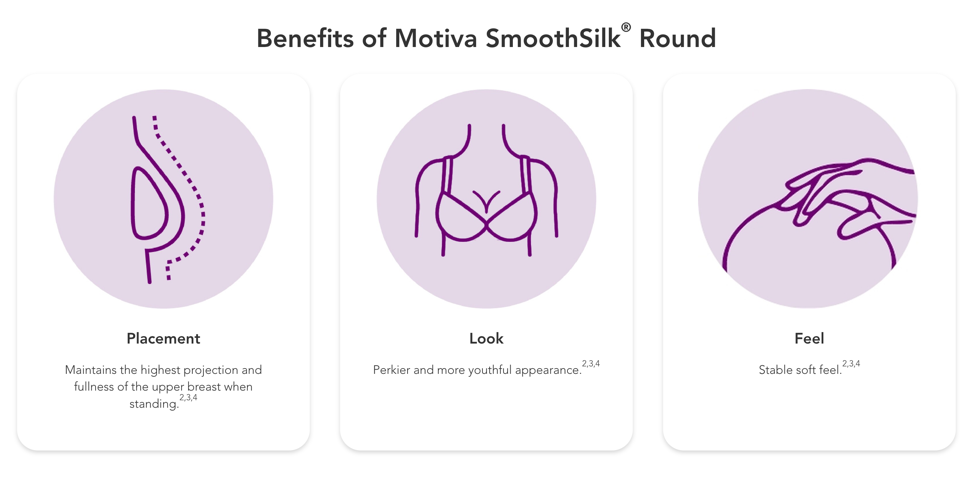
ProgressiveGel Plus is the firmer silicone gel used inside Motiva’s Round implants. It maintains the implant’s full shape, especially in the upper pole, providing more consistent projection regardless of body position. Think of it as the “hold your shape” option.
ProgressiveGel Ultima (Motiva Ergonomix)
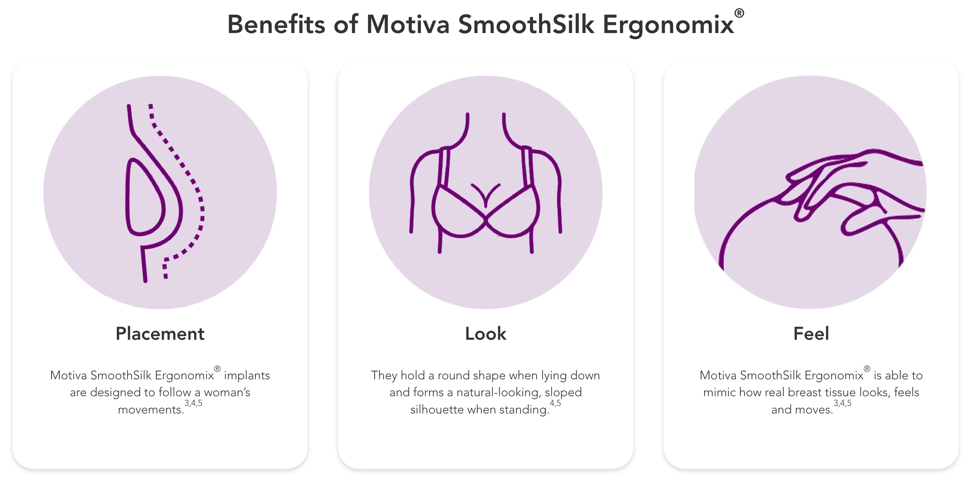
ProgressiveGel Ultima is a softer, more flexible silicone gel used in Motiva’s Ergonomix implants. It allows the implant to respond dynamically to gravity and body movement. The result is an implant that looks more round when you’re lying down and more teardrop-shaped when you’re standing, mimicking how natural breast tissue behaves.
High-Strength Cohesive Gel / HSC+ (Sientra)
Sientra’s gel technology is built on cohesive silicone designed to retain shape while still providing a natural feel. Their shaped implants use a slightly higher-crosslinked gel (HSC+) for greater form stability. Sientra’s round implants use a softer cohesive fill that prioritizes natural movement over rigid shape retention.
TrueMonoBloc (Motiva)
TrueMonoBloc is Motiva’s design principle where the elasticity of the shell and the silicone gel inside are matched, so the implant moves as a single, complete unit rather than having gel sloshing independently inside a separate shell. Combined with 100% fill volume, this is how Motiva achieves an implant that feels extremely soft but still holds its shape. It’s the engineering behind why many surgeons describe Motiva’s feel as distinctly natural.
Ergonomix (Motiva)
Ergonomix is Motiva’s adaptive-shape implant. It’s technically a round implant, but the ProgressiveGel Ultima inside allows it to shift between round (when lying flat) and teardrop (when upright). This is different from a traditional shaped implant, which holds one fixed form at all times. For patients who want the natural look of a teardrop shape without the rotation risk of a fixed anatomical implant, Ergonomix offers a middle ground.
For a full breakdown of available profiles and sizes, see the Motiva implants chart and profiles guide.
Cohesive Gel / “Gummy Bear” Implant
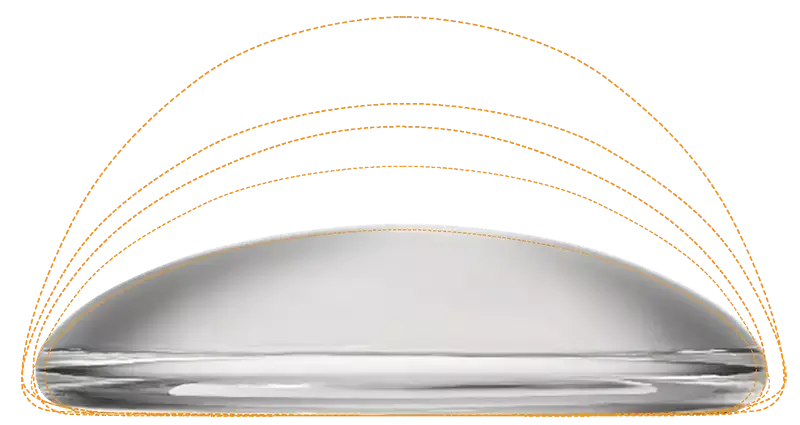
“Gummy bear” is a colloquial term used across all silicone gel breast implant brands. It refers to highly cohesive silicone gel that holds its shape even if the shell is cut open, similar to how a gummy bear candy maintains its form. Both Motiva and Sientra use cohesive gel, though the specific formulations, crosslinking density, and feel vary between brands and product lines. Don’t assume all “gummy bear” implants are the same. The term is more marketing shorthand than precise technical specification.
BluSeal (Motiva)
BluSeal is a visual safety feature built into every Motiva implant shell. It’s a barrier layer that turns the silicone slightly blue at the shell’s surface. If there’s a breach in shell integrity, the blue tint becomes visible, giving surgeons an immediate visual cue during examination or revision surgery. No other breast implant brand currently offers a comparable visual integrity indicator.
Safety and Complication Terms
This is where the Motiva implants vs Sientra comparison gets most intense, and where the data needs the most careful framing.
Capsular Contracture
Capsular contracture is the most common complication after breast augmentation. Every implant triggers your body to form a thin layer of scar tissue (a capsule) around it. That’s normal. Capsular contracture happens when the capsule tightens and squeezes the implant, causing hardness, discomfort, visible distortion, or pain.
Rupture Rate
Rupture means the implant shell has developed a tear or hole. With modern cohesive gel implants, a rupture usually doesn’t cause silicone to leak freely (it stays contained within the cohesive gel mass), but it still typically warrants implant removal or exchange.
Motiva: approximately 0.6% rupture rate at 3 to 5 years in the FDA clinical trial MRI cohort.
Sientra (10-year core study): 8.6% rupture rate by patient.
Again, the timeframe caveat applies. Five-year data and ten-year data are not directly comparable. But Motiva’s early rupture numbers are unusually low.
If you’re thinking about what a revision or exchange looks like, see the guide on implant exchange.
Placement and Surgical Terms
Submuscular (Under the Muscle)
The implant is placed beneath the pectoralis major muscle. The muscle provides an extra layer of tissue coverage, reducing visible implant edges and potentially lowering capsular contracture rates. The downside is animation deformity and a slightly longer recovery.
Subglandular (Over the Muscle)
The implant is placed above the muscle, directly behind the breast tissue. This avoids animation deformity, often provides a faster recovery, and can create a more natural breast shape in patients with adequate tissue coverage.
Dual Plane
A hybrid technique where the upper portion of the implant sits behind the muscle while the lower portion is covered only by breast tissue. It combines some benefits of both submuscular and subglandular placement. Many surgeons use dual plane as their default approach regardless of implant brand.
Inframammary Fold (IMF)
The inframammary fold is the natural crease where the underside of the breast meets the chest wall. It’s a critical anatomical landmark in breast augmentation because the surgeon uses it to define the lower boundary of the implant pocket. Reinforcing the IMF closure is especially important with Motiva implants, where the minimal capsule formation means the fold provides a larger share of the structural support keeping the implant in position.
Preservé Technique
Preservé is a Motiva-specific subfascial surgical approach where the implant is placed beneath the fascia (a thin but strong connective tissue layer covering the muscle) rather than under the muscle itself. It aims to provide some of the tissue coverage benefits of submuscular placement while avoiding animation deformity. Not all surgeons offer this technique. Dr. Mundra is trained in Preservé breast augmentation with Motiva Ergonomix implants. Learn more about the difference between a traditional breast augmentation and Preservé.
Learn what to expect at a breast augmentation consultation.
Warranty and Coverage Terms
Warranty programs are a practical differentiator when comparing Motiva implants vs Sientra, and the enrollment details matter more than patients realize.
Always Confident Warranty (Motiva)
Motiva’s base warranty covers rupture for the lifetime of the device and provides implant replacement for capsular contracture for 10 years. This warranty requires active registration, which is an important detail your surgeon’s office should handle.
Platinum20 (Sientra)
Sientra’s Platinum20 warranty automatically applies to all Sientra silicone gel breast implants implanted in the U.S. or Puerto Rico on or after May 1, 2018. No registration is required from the patient. It covers lifetime rupture replacement plus $2,000 toward costs related to covered events. Premium tiers offer up to $7,500 toward revision costs.
The automatic enrollment is a genuine Sientra advantage. There’s no paperwork to forget, no 90-day registration window to miss. If your implant qualifies and was placed after the program launch date, you’re covered.
Qid / Q Inside Safety Technology (Motiva)
Qid is a tiny RFID microchip embedded in select Motiva implants. It stores the implant’s serial number, lot number, and specifications, which can be read with an external scanner. This means your implant can be identified without surgery, useful in medical emergencies, future consultations with different surgeons, or if records are lost. It also affects which warranty tier your implant qualifies for. No other breast implant brand offers embedded identification technology.
Candidacy Terms
Profile
Profile refers to how far the implant projects forward from the chest wall relative to its base width. Both Motiva and Sientra offer multiple profile options, though they use different naming conventions:
Motiva profiles: Mini, Demi, Full, Corsé (ranging from low to high projection)
Sientra profiles: Low, Moderate, Moderate Plus, High, Xtra High
Higher profile implants project more for a given base width, which matters for patients with narrower chest walls who still want noticeable projection. Lower profiles create a wider, more subtle slope. Your surgeon will match the profile to your chest measurements and aesthetic goals.
Base Width
Base width is the diameter of the implant measured across its widest point. It’s one of the most important numbers in implant selection because your natural breast width and chest wall dimensions set a physical limit on how wide an implant can be without looking unnatural or causing complications. An implant that’s too wide for your frame can cause lateral displacement, visible edges, or tissue stretch over time.
Ready to compare Motiva and Sientra with plastic surgeon who offers both? Contact the office to schedule your personalized consultation.
Frequently Asked Questions
Are Motiva implants better than Sientra?
Neither is objectively better. Motiva shows lower complication rates in early data (five years), offers adaptive gel technology, and has an innovative surface design. Sientra has a much longer track record (10+ years of published data), and is approved for reconstruction. The best implant is the one that matches your anatomy, goals, and surgeon’s expertise.
How long do Motiva and Sientra implants last?
No breast implant is guaranteed to last forever. Both brands are designed for long-term use, but complications like capsular contracture or rupture can necessitate replacement. Motiva’s 5-year data shows a 0.6% rupture rate. Sientra’s 10-year data shows an 8.6% rupture rate. These numbers aren’t directly comparable due to the different timeframes, but both indicate that the majority of implants remain intact for many years.
What is the Motiva Ergonomix implant, and does Sientra have something similar?
Ergonomix is Motiva’s adaptive-shape implant, using a flexible gel that shifts between round (lying down) and teardrop (standing). Sientra doesn’t offer an adaptive implant rather round implants.
Do I need to register my Motiva implants for warranty coverage?
Yes. Motiva’s warranty requires registration, and your surgeon’s office typically handles this. Missing the registration window could affect your coverage. Sientra’s Platinum20 warranty, by contrast, enrolls automatically for all implants placed after May 1, 2018, with no action required from the patient or surgeon.
Which implant is safer regarding BIA-ALCL?
Both brands have reported zero BIA-ALCL cases in their clinical studies. The primary risk factor for BIA-ALCL is macro-textured implant surfaces. Motiva only offers its SmoothSilk surface (not classically textured), while Sientra offers both smooth and textured options. If BIA-ALCL risk is a top concern, discussing surface choice with your surgeon is more important than brand choice alone.