
Motiva vs Allergan Natrelle: 2026 Guide to Key Differences
TL;DR
Motiva and Allergan Natrelle are the two most researched breast implant brands in the U.S. right now. Motiva earned FDA approval in September 2024 and brings newer gel and shell technology with early clinical data showing very low complication rates. Natrelle has decades of U.S. track record, a wider range of profiles and gel options, and well-established long-term safety data. The right choice depends on your anatomy, aesthetic goals, and what your surgeon recommends during a one-on-one consultation.
Schedule a breast augmentation consultation with Dr. Leela, Harvard trained plastic surgeon to discuss which implant fits your goals.
Why This Comparison Matters Right Now
If you’re researching Motiva vs Allergan Natrelle, you’re not alone. RealSelf data from early 2026 shows that brand-specific implant searches are surging, with Motiva queries up 214% and Natrelle queries up 157%. Patients are arriving at consultations more informed than ever, asking pointed questions about gel types, shell technology, and complication rates.
This glossary defines every term you’ll encounter during that research. Each entry includes a plain-English explanation, the clinical context behind it, and how it applies to the Motiva vs Natrelle decision. The goal isn’t to pick a winner. It’s to help you walk into your consultation already speaking the language.
Brand Overviews
Motiva (Establishment Labs)
Establishment Labs, founded in 2004 and headquartered in Costa Rica, manufactures Motiva implants. The devices launched globally around 2010 and have been used in over 85 countries. In September 2024, Motiva received FDA approval for breast augmentation, making it the first new breast implant PMA approved by the U.S. FDA since 2013. Since that approval, more than 60,000 Motiva implants have been sold in the United States.
Two models are available: the SmoothSilk Round and the SmoothSilk Ergonomix. Motiva’s FDA approval currently covers breast augmentation only. Use for breast reconstruction remains investigational in the U.S., with Establishment Labs submitting for that indication in December 2025.
Natrelle (Allergan Aesthetics / AbbVie)
Natrelle implants, made by Allergan Aesthetics (now part of AbbVie), have been a fixture in the U.S. market for decades. The Inspira SoftTouch line, their current flagship for cosmetic augmentation, received FDA approval in 2017. Natrelle offers five profile options (from low to extra full) and three distinct gel consistencies, giving surgeons a broad toolkit for matching implants to individual body types.
One important clarification: Allergan’s macrotextured BIOCELL surface was recalled globally in 2019 due to BIA-ALCL risk. Today’s Natrelle smooth implants, including the entire Inspira line, were not part of that recall. This distinction matters and comes up repeatedly when patients compare Motiva vs Allergan Natrelle.
Learn more about Natrelle breast implants and the options available.
Gel Technology Terms
Understanding gel technology is the fastest way to grasp how these two implants actually feel and behave inside the body.
Rheology
Rheology is the science of how materials flow and deform. In breast implants, it determines how the silicone gel responds to gravity, movement, and compression. A gel with high viscoelasticity bounces back to its original shape after being pressed. A gel with lower cohesivity flows more freely.
Why it matters: rheology is the reason two implants of the same size and projection can feel completely different on the body. It’s the single biggest differentiator in the Motiva vs Allergan Natrelle comparison.
ProgressiveGel Ultima (Motiva Ergonomix)
This is the gel inside Motiva’s Ergonomix implant. It’s a soft, highly viscoelastic silicone designed to respond dynamically to body position. When you stand, the gel settles into a teardrop shape with a gentle slope. When you lie down, it spreads into a rounder profile.
ProgressiveGel Plus (Motiva Round)
The firmer of Motiva’s two gel options. ProgressiveGel Plus maintains a consistent round shape regardless of body position, whether you’re standing, lying down, or leaning forward. Patients seeking visible upper-pole fullness and defined cleavage tend to prefer this option.
Natrelle Inspira Collection Gels
Natrelle doesn’t use a single gel type. The Inspira Collection offers three distinct consistencies:
Responsive: The softest option, designed for a natural feel
SoftTouch: A mid-range cohesivity balancing softness with shape retention (this is the most commonly used)
Cohesive: The firmest, offering the most shape stability
This range is one of Natrelle’s genuine strengths. It gives surgeons the ability to fine-tune gel firmness for each patient’s tissue type and goals. If you want to understand how sizing and profiles factor in, our implant profiles and sizes guide breaks that down further.
Cohesivity
How well a silicone gel holds together when cut or compressed. Higher cohesivity means the gel stays in place and doesn’t migrate, but it also means a firmer feel. Lower cohesivity allows more natural movement but offers less shape stability. In the Motiva vs Natrelle comparison, Motiva Ergonomix sits at the lower end of the cohesivity spectrum (by design), while Natrelle SoftTouch sits in the middle.
Viscoelasticity
A gel’s ability to return to its original shape after being stretched or compressed. Think of it as “memory.” Motiva’s proprietary gels score high on viscoelasticity testing, which is why the implant can change shape with movement and then return to baseline. This is different from older gels that might deform permanently under sustained pressure.
Shell and Surface Technology Terms
The implant shell is the silicone envelope surrounding the gel. Its surface, thickness, and elasticity all influence how the implant interacts with your body over time.
SmoothSilk (Motiva)
Motiva’s proprietary shell surface features a 4-micron “nano-smooth” topography. It’s technically nano-textured, but it behaves like a smooth implant. The surface is too fine for bacteria to anchor easily, which helps the body form a thinner, more pliable capsule around the implant. This is a meaningful distinction from both traditional smooth shells and the macrotextured surfaces that have been linked to complications.
According to the surface characteristics classification scale, Motiva implants sit at the lowest grade, which correlates with negligible BIA-ALCL risk. To date, zero cases of BIA-ALCL have been reported with Motiva implants.
Smooth Shell (Natrelle Inspira)
Today’s Natrelle Inspira implants use a traditional smooth shell. After the 2019 BIOCELL recall, Allergan’s remaining U.S. lineup for breast augmentation is entirely smooth-surfaced. Smooth shells have a long safety track record and are the standard across the industry.
TrueMonobloc (Motiva)
In most implants, the shell and the gel inside have different elasticity levels. This means the gel can move independently of the shell, sometimes creating a “sloshing” sensation. Motiva’s TrueMonobloc technology matches the elasticity of the shell and gel so the implant moves as a single unit.
BluSeal (Motiva)
A light blue, biocompatible barrier layer applied to the inside of Motiva’s shell. It serves two purposes: it reduces gel leakage through the shell, and its blue color provides visual confirmation of shell integrity. If the shell were compromised, the blue layer would be visible on imaging.
INTRASHIELD (Natrelle)
Natrelle’s equivalent barrier technology. INTRASHIELD minimizes gel diffusion through the shell to less than 1%. Both BluSeal and INTRASHIELD address the same concern (gel bleed), using different engineering approaches.
Gel Bleed
The slow migration of microscopic silicone particles through an intact implant shell. This is a normal phenomenon with all silicone implants, but modern barrier technologies like BluSeal and INTRASHIELD have reduced it to clinically insignificant levels. If gel bleed concerns you, know that both Motiva and Natrelle have addressed it with dedicated barrier layers.
Safety and Complication Terms
This section matters most to patients comparing Motiva vs Allergan Natrelle. Read the data carefully, and pay attention to the timeframe caveats.
Capsular Contracture
After any implant is placed, the body forms a thin capsule of scar tissue around it. This is normal. Capsular contracture occurs when that capsule tightens excessively, squeezing the implant and causing firmness, discomfort, or visible distortion.
For patients dealing with capsular contracture from a previous augmentation, breast implant revision may be worth exploring.
Rupture Rate
How often an implant’s shell fails, allowing gel to leak. Motiva reports rupture rates as low as 0.6% at 3 to 5 years based on FDA MRI cohort data. Natrelle’s 10-year MRI cohort data shows higher rates, which is expected given the longer follow-up period. As with capsular contracture, timeframe differences make direct comparison difficult.
BIA-ALCL (Breast Implant-Associated Anaplastic Large Cell Lymphoma)
A rare cancer of the immune system that develops in the scar tissue capsule around breast implants. It is not breast cancer. At the time of Allergan’s 2019 recall, the FDA had identified 573 unique BIA-ALCL cases globally. Of those, 481 (84%) were linked to Allergan’s macrotextured BIOCELL surface. The FDA determined that the risk from an Allergan textured implant was roughly six times greater than from other manufacturers’ implants.
Two things to understand clearly:
The recalled BIOCELL textured implants are no longer on the market. Today’s Natrelle Inspira smooth implants were not recalled and carry a different risk profile.
Motiva’s SmoothSilk surface is classified at the lowest risk grade. No cases of BIA-ALCL have been reported with Motiva implants.
This is one of the most emotionally charged topics in the Motiva vs Allergan Natrelle conversation.
Shape, Profile, and Sizing Terms
Upper Pole Fullness
The roundness and volume visible in the top half of the breast, above the nipple line. This is the “perky” look many patients reference. Natrelle SoftTouch has higher shape retention, meaning it holds its round shape more consistently and delivers more upper pole fullness. Motiva Round (with ProgressiveGel Plus) also provides this, though through different gel engineering.
Some patients pair augmentation with a breast lift to maximize upper pole results, particularly if they have existing skin laxity.
Dynamic Shape Adaptation
The hallmark behavior of Motiva Ergonomix. Rather than maintaining one fixed shape, the implant transitions between rounder (when lying down) and more teardrop-shaped (when standing). This mimics the way natural breast tissue responds to gravity. Patients seeking the most subtle, “no one can tell” result often gravitate toward this feature.
Implant Profiles: Motiva vs Natrelle
Profile refers to how far the implant projects from the chest wall relative to its base width.
Motiva offers three profiles: Mini, Demi, and Full.
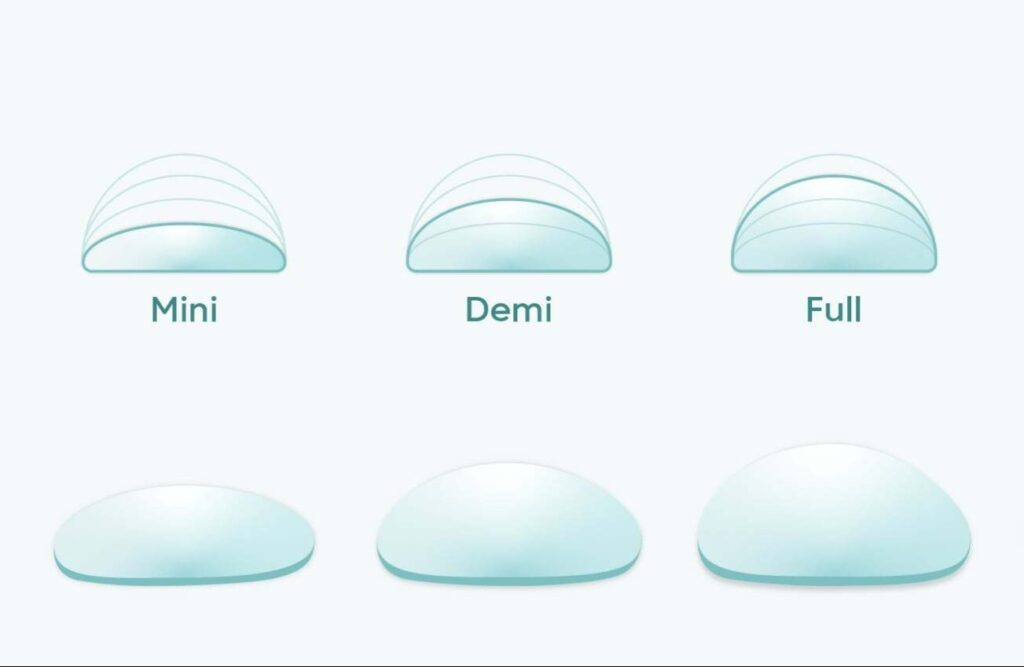
Natrelle Inspira offers five: Low, Low Plus, Moderate, Full, and Extra Full.
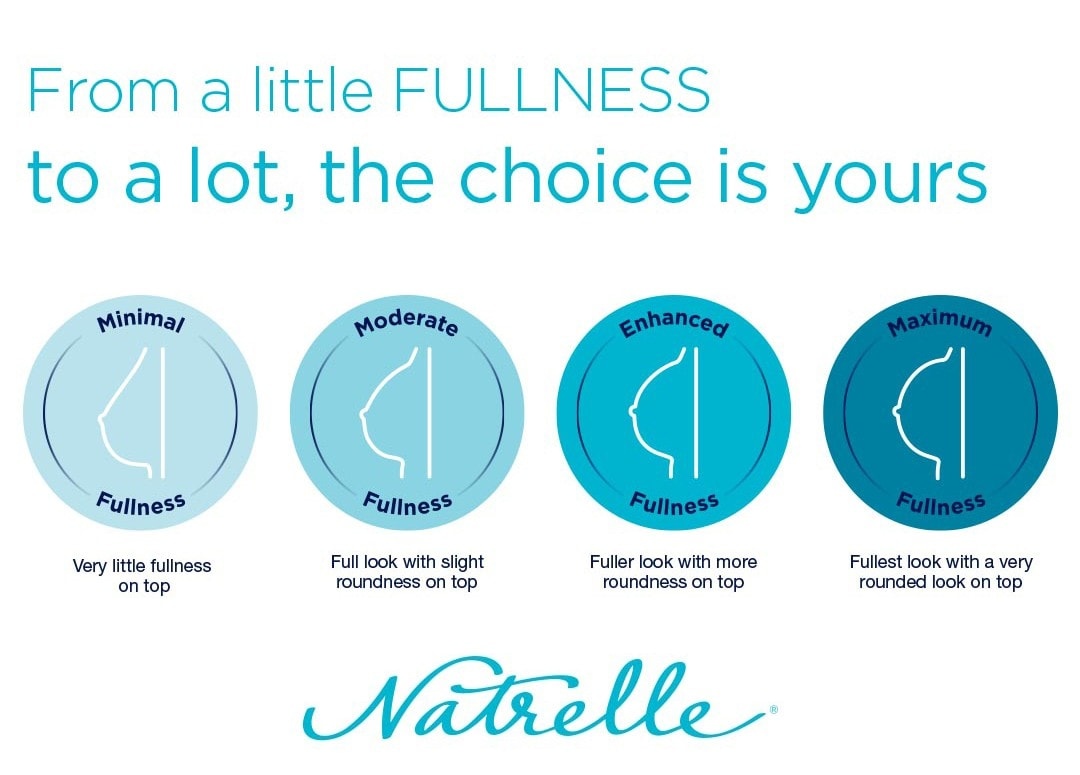
Natrelle’s broader profile range gives surgeons more granularity when matching the implant to a specific chest wall width and desired projection. This is a practical advantage for patients whose anatomy falls between standard profile categories. Our Motiva implant chart guide can help you visualize how profiles translate to actual dimensions.
Ergonomix vs. Round (Motiva’s Two Options)
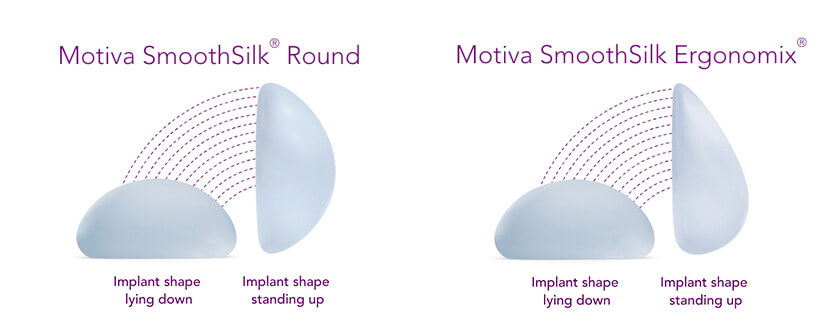
Motiva Ergonomix uses ProgressiveGel Ultima for dynamic, gravity-responsive behavior. Best for patients wanting a natural, subtle result.
Motiva Round uses ProgressiveGel Plus for consistent shape and upper pole fullness. Best for patients wanting a defined, round aesthetic.
Both use the same SmoothSilk shell and BluSeal barrier. The gel is the only difference.
The Inspira Collection (Natrelle’s Current Lineup)
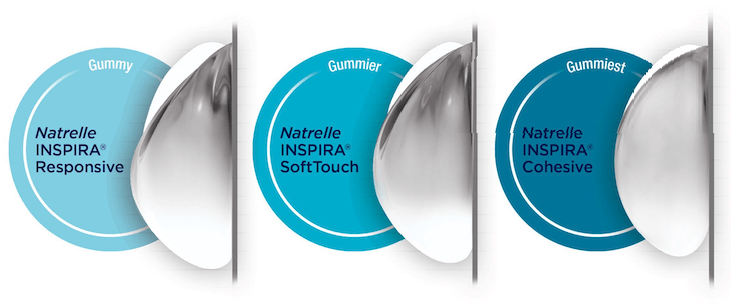
Natrelle’s flagship smooth implant line for cosmetic augmentation. It combines five profile options with three gel consistencies (Responsive, SoftTouch, Cohesive), creating a large matrix of possible combinations. This flexibility is one reason Natrelle remains the most commonly used implant in U.S. breast augmentation, even as Motiva gains market share.
Warranty and Protection Terms
Warranty coverage is one of the most under-discussed aspects of the Motiva vs Allergan Natrelle comparison, and one of the most practically important.
Always Confident Warranty (Motiva)
Motiva covers implant rupture for the lifetime of the device. Capsular contracture (Baker grades III and IV) is covered for 10 years. The program provides up to $5,000 in financial assistance for rupture for up to 20 years.
Confidence Plus (Natrelle)
All Natrelle implants come with an automatic 10-year warranty. In the case of rupture or deflation, the program offers up to $3,500 to cover out-of-pocket expenses not reimbursed by insurance. An upgraded Confidence Plus Premiere warranty is available for purchase, extending coverage.
Warranty Comparison at a Glance
Feature | Motiva (Always Confident) | Natrelle (Confidence Plus) |
|---|---|---|
Rupture replacement | Lifetime | 10 years |
Capsular contracture coverage | 10 years (Baker III/IV) | Limited |
Financial assistance (rupture) | Up to $5,000 for 20 years | Up to $3,500 for 10 years |
Explant assistance | Up to $2,500 (2 years) | Not offered |
Upgrade option | Extended programs available | Confidence Plus Premiere (paid) |
Q Inside / Qid (Motiva)
An RFID microtransponder embedded in Motiva implants that allows post-surgical identification of the device without imaging. Useful for medical records, implant tracking, and any future revision or exchange procedure. Natrelle implants do not include an equivalent technology.
Incision Size
Motiva’s shell flexibility allows placement through incisions as small as 2.5 centimeters, roughly one inch. Traditional silicone implants typically require 3 to 5 centimeter incisions. For patients concerned about visible scarring, this is a tangible benefit. Our guide on breast implant scars covers this topic in detail.
Patient Satisfaction and Adoption Trends
Motiva reports 97% patient satisfaction at five years in their clinical studies.
That said, Natrelle SoftTouch remains enormously popular for good reason. Its shape retention delivers the consistent, round aesthetic that many patients specifically want. The “best” implant is the one that matches your goals.
If you’re considering switching from one brand to another, an implant exchange is a straightforward procedure worth discussing.
Which Implant for Which Goal?
This is the section most patients actually need. Use it as a starting point for your consultation conversation, not as a final answer.
Your Priority | Consider |
|---|---|
Most natural movement and feel | Motiva Ergonomix |
Consistent upper pole fullness (“perky” look) | Natrelle SoftTouch or Motiva Round |
Thin tissue or low body fat (rippling concern) | Motiva (lower rippling per practitioner reports) |
Broadest profile and size range | Natrelle Inspira (5 profiles, 3 gels) |
Lowest reported capsular contracture rates | Motiva (with the 3-year data caveat) |
Longest U.S. track record | Natrelle |
Strongest warranty coverage | Motiva (lifetime rupture, 20-year financial assistance) |
Smallest possible incision | Motiva (~2.5 cm) |
No comparison table replaces a physical examination and an honest conversation about your anatomy, lifestyle, and expectations. The surgeon’s experience with each device matters as much as the device itself.
Contact us to schedule your consultation and discuss which implant is right for your body and goals.
Frequently Asked Questions
Is Motiva or Natrelle better for a natural look?
Motiva Ergonomix is specifically designed for natural movement, adapting its shape based on body position. However, “natural” means different things to different patients. Some prefer the consistent roundness of Natrelle SoftTouch because it matches their idea of how they want to look. Your tissue characteristics and chest wall dimensions play a bigger role than brand alone.
Are Motiva implants safe given they’re newer to the U.S.?
Motiva received FDA approval in September 2024, but the implants have been used internationally since around 2010 in over 85 countries. Early clinical data shows capsular contracture rates between 0.5% and 1.8% at three years and rupture rates as low as 0.6%. Over 60,000 Motiva implants have been sold in the U.S. since approval. Long-term U.S. data is still accumulating, which is worth keeping in mind.
Should I worry about BIA-ALCL with Natrelle implants?
Today’s Natrelle Inspira smooth implants were not part of the 2019 BIOCELL recall. The recalled devices were macrotextured implants with a specific surface that is no longer sold. If you’re receiving smooth Natrelle implants for cosmetic augmentation, the BIA-ALCL risk profile is very different from what led to the recall.
Which implant has a better warranty?
Motiva’s Always Confident Warranty offers lifetime rupture replacement and up to $5,000 in financial assistance for 20 years. Natrelle’s Confidence Plus provides 10 years of coverage with up to $3,500 in financial assistance. Motiva also offers a unique explant assistance program (FemTech Freedom) that Natrelle does not match. On paper, Motiva’s warranty is more comprehensive.
Can I switch from Natrelle to Motiva (or vice versa)?
Yes. Implant exchange is a well-established procedure. The reverse is also possible if a patient prefers Natrelle’s characteristics. Your surgeon can evaluate whether a straightforward exchange is feasible or whether additional work (like capsule management) is needed.
Does Motiva really allow smaller incisions?
Yes. Motiva’s flexible shell allows placement through incisions as small as 2.5 centimeters. Traditional silicone implants typically require 3 to 5 centimeter incisions. The difference is modest but can matter for patients who prioritize minimal scarring, particularly with inframammary or periareolar approaches.
How do I decide between Motiva vs Allergan Natrelle?
Start with your goals. If natural movement and the softest possible feel are priorities, Motiva Ergonomix deserves serious consideration. If you want consistent upper pole fullness with a proven long-term track record, Natrelle SoftTouch is a strong choice. From there, your anatomy, tissue thickness, and surgeon’s experience with each device will narrow the decision. The consultation is where this becomes personal rather than theoretical.
Learn what to expect at your consultation so you can arrive prepared.