
Motiva vs Sientra (2026): Safety, Feel, Cost & Warranty

TL;DR
Motiva and Sientra are both FDA-approved silicone gel breast implants, but they differ significantly in technology, safety data, warranty coverage, and ideal patient fit. Motiva received FDA approval in September 2024 with standout short-term safety numbers, while Sientra has been FDA-approved since 2012 with over a decade of published long-term data. The right choice depends on your anatomy, aesthetic goals, and how you weigh proven track records against newer technology.
If you’re comparing Motiva vs Sientra breast implants, you’re already past the “should I get implants?” question and into the harder one: which implant is right for my body and my goals? That’s a good place to be, but the amount of technical jargon involved can make the decision feel overwhelming.
This guide breaks down both brands, defines every term you’ll encounter during your research, and gives you a practical framework for understanding how these implants actually differ. Both are excellent options, and both are offered by plastic surgeons across the country, including at practices here in Denver that specialize in breast augmentation.
The goal isn’t to declare a winner. It’s to help you walk into your consultation armed with real knowledge.
Motiva Implants: Definition and Key Terms

What Motiva implants are: Motiva implants are 6th-generation silicone gel breast implants manufactured by Establishment Labs, a Costa Rica-based company. They received FDA approval in September 2024 for primary and revision breast augmentation, making them the first new breast implant to earn FDA premarket approval since 2013. Before entering the U.S. market, Motiva had been used in over 86 countries for more than 14 years, with nearly 4 million devices placed globally. Since approval, more than 60,000 Motiva implants have been sold in the United States.
Motiva comes in two styles: the Ergonomix (which adapts shape with body position) and the Round (which maintains a round form regardless of position). Here are the proprietary technologies you’ll see referenced:
SmoothSilk® surface: Motiva’s shell has a nano-textured surface at the microscopic level, giving it an almost silky feel. Despite this micro-texturing, the FDA classifies it as a smooth implant because the surface treatment is so fine. This distinction matters because textured implants have been associated with BIA-ALCL (more on that below), and Motiva has zero reported cases of BIA-ALCL to date.
ProgressiveGel® (Ultima and Plus): Motiva’s proprietary silicone gel is designed to mimic the way natural breast tissue moves. The gel adapts to pressure and position changes rather than maintaining a rigid shape. ProgressiveGel Ultima is the softer version used in Ergonomix implants, while ProgressiveGel Plus offers more structure for the Round style.
Ergonomix® design: This is Motiva’s flagship shape-adaptive implant. When you’re standing, it takes on a more teardrop silhouette. When you’re lying down, it rounds out. The idea is to replicate how a natural breast changes shape with gravity and movement.
TrueMonoBloc® technology: In most silicone implants, the gel can move somewhat independently inside the shell. With TrueMonoBloc, the elasticity of the shell and the gel are matched so they move as a single unit.
BluSeal® indicator: A blue-tinted barrier layer built into the shell. If the implant shell is compromised, the blue tint becomes visible, providing a visual integrity check during surgery or imaging.
Q Inside Safety Technology™: A tiny RFID micro-transponder embedded in the implant that stores the device’s serial number and specifications. It allows for quick identification if you ever need revision surgery or implant verification. Registration is required within 90 days of surgery.
Sientra Implants: Definition and Key Terms
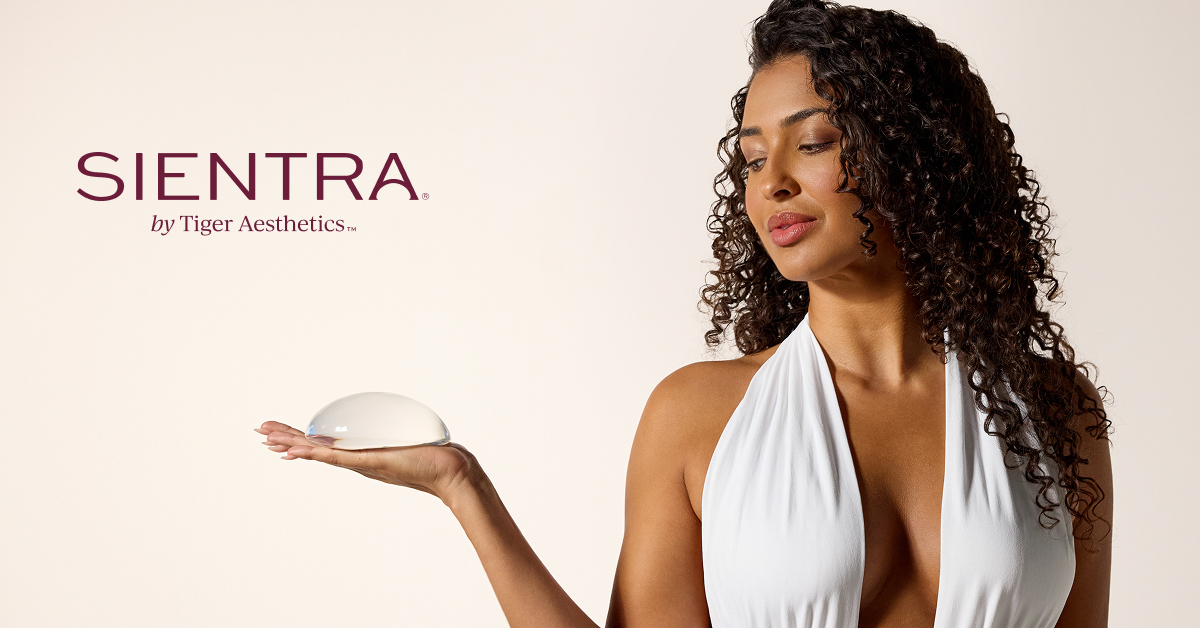
What Sientra implants are: Sientra manufactures 5th-generation silicone gel breast implants that received FDA approval in March 2012, based on what was then the largest silicone gel breast implant study ever conducted. Sientra is now owned by Tiger Aesthetics Medical and headquartered in Santa Barbara, California. The company is approved for both breast augmentation (in women 22 and older) and breast reconstruction, a distinction that matters for certain patients.
One unique feature of Sientra’s business model: they only sell their implants to board-certified or board-eligible plastic surgeons. If your surgeon uses Sientra, that credential check is already built into the process.
High-Strength Cohesive (HSC) gel: Sientra’s gel is designed to be firmer and more shape-retaining than standard silicone fill. Surgeons who prefer Sientra often point to this cohesivity as an advantage for achieving upper pole fullness, the rounded look above the nipple that many patients request.
Round and shaped (anatomical) options: Sientra was the first company to receive FDA approval for shaped silicone gel implants in the U.S. Shaped implants have more projection at the bottom and a tapered upper pole, creating a teardrop silhouette. For patients wanting this look with a traditional implant approach, Sientra implants remain a strong choice.
Head-to-Head Comparison: Motiva vs Sientra
This table provides a direct Motiva vs Sientra comparison across the metrics that matter most to patients and surgeons.
Feature | Motiva | Sientra |
|---|---|---|
FDA approval year | September 2024 | March 2012 |
Implant generation | 6th generation | 5th generation |
Surface type | SmoothSilk (nano-textured, classified smooth) | Smooth options |
Gel type | ProgressiveGel (adaptive, soft) | High-Strength Cohesive gel (firmer, shape-retaining) |
Available shapes | Ergonomix (adaptive) and Round | Round and Shaped (anatomical) |
Capsular contracture rate | Below 1% (5-year FDA trial) | 13.5% at 10 years (core study); 4.1% at 6 years (postapproval study) |
Rupture rate | 0.6% (5-year FDA trial) | 8.6% at 10 years (core study) |
Reoperation rate | ~8.8% at 5 years | 31.5% at 10 years (core study); 11.6% at 6 years (postapproval) |
Reported BIA-ALCL cases | Zero | Cases linked to textured implants industry-wide |
Warranty duration | Lifetime (rupture); 10 years (capsular contracture) | 20 years (Platinum20™) |
Financial assistance (rupture) | Up to $2,500/implant (extended warranty, $200 fee) | Up to $5,000 for uncovered fees |
Financial assistance (capsular contracture) | Product replacement (10 years) | Up to $2,000 (2 years) + free replacement (20 years) |
Surgeon restriction | Board-certified/board-eligible only | Board-certified/board-eligible only |
Typical cost premium | 15-20% above traditional silicone | Standard silicone pricing |
U.S. data track record | ~5 years (FDA trial) | 10+ years published |
Reconstruction approval (U.S.) | Not yet | Yes |
Sources: Motiva safety data from FDA clinical trial results; Sientra 10-year data from Stevens et al., Plast Reconstr Surg 2018; Sientra 6-year postapproval data from PMC published study.
A critical note about these numbers: Comparing 5-year data to 10-year data is not apples to apples. Complication rates generally increase over time, so Motiva’s numbers will likely rise as longer surveillance data becomes available.
Key Comparison Terms Defined
When researching Motiva vs Sientra, you’ll encounter terminology that sounds technical but is straightforward once explained. Here’s a plain-language glossary of the concepts that matter most.
Capsular Contracture and Baker Grading
When any implant is placed in the body, the immune system forms a thin layer of scar tissue around it called a capsule. This is normal. Capsular contracture happens when that capsule tightens and squeezes the implant, causing firmness, discomfort, or visible distortion.
BIA-ALCL (Breast Implant-Associated Anaplastic Large Cell Lymphoma)
BIA-ALCL is a rare type of non-Hodgkin lymphoma that develops in the scar tissue surrounding a breast implant. It is not breast cancer. The vast majority of confirmed cases have been linked to macro-textured implant surfaces. Motiva’s SmoothSilk surface has zero reported cases. Sientra offers both smooth and textured options, so the BIA-ALCL discussion becomes relevant primarily with their textured line.
Reoperation Rate
This measures how often patients need additional surgery after their initial augmentation, for any reason: capsular contracture, implant rupture, size change, malposition, or cosmetic dissatisfaction. It’s arguably the most practical number for patients because it captures real-world outcomes. Comparing reoperation rates across brands is tricky, though, because study designs, follow-up periods, and patient populations differ.
Silicone Cohesivity
Cohesivity refers to how well silicone gel holds together. Think of a spectrum: on one end, a very cohesive (“gummy bear”) gel that maintains its shape even if the shell breaks. On the other end, a softer, more fluid gel that moves more naturally but provides less structural support. Motiva’s ProgressiveGel sits toward the softer end. Sientra’s HSC gel sits closer to the firmer, more structured end. Neither is objectively better. The right cohesivity depends on your body type, tissue coverage, and desired look.
Implant Profile
Profile describes how far the implant projects from the chest wall relative to its base width. Common categories include low, moderate, moderate-plus, full, and high. A narrow-chested patient who wants significant projection would need a higher profile. A broader-chested patient might achieve the same look with a moderate profile. Both Motiva and Sientra offer multiple profile options, and your surgeon will match profile to your chest measurements during consultation.
Subfascial vs. Subpectoral Placement
Subpectoral (under the muscle): The implant sits partially or fully beneath the pectoralis major muscle. This provides additional tissue coverage over the implant and has historically been the most common placement.
Subfascial (above the muscle, under the fascia): The implant sits on top of the chest muscle but beneath the thin, strong connective tissue layer (fascia) that covers it. With improvements in 6th-generation implants, surgeons can now achieve natural results above the muscle even in thinner women. Motiva’s softer gel and SmoothSilk surface make it a particularly strong candidate for subfascial placement, which is a genuine differentiator that comes up during planning for a breast augmentation with lift as well.
Fold Fatigue and Rippling
Fold fatigue refers to the weakening of an implant shell at points where it creases repeatedly. Over years, this can contribute to rupture. Rippling is when the edges or folds of an implant become visible or palpable through the skin, particularly in thin patients with less tissue coverage. Softer gels (like Motiva’s) tend to produce less visible rippling in many cases, though placement and tissue thickness matter more than brand alone.
When Motiva May Be the Better Fit
Motiva tends to be the stronger choice for patients in these situations:
You prioritize the softest, most natural feel.
You have a history of capsular contracture. Motiva’s SmoothSilk surface and gel formulation appear to trigger minimal inflammatory response. Motiva implants form virtually no capsule in most patients, which is strikingly different from the fibrous capsule that classically forms around implants from other manufacturers. For patients undergoing implant exchange after capsular contracture with another brand, this is a meaningful consideration.
You’re lean or thin and considering above-muscle placement. Motiva’s adaptive gel and low-profile detectability make subfascial placement a viable option even for patients without a lot of natural breast tissue.
You want the lowest available capsular contracture data. At under 1% in 5-year FDA trials, Motiva’s capsular contracture rate is the lowest ever recorded in an FDA breast implant study.
An important caveat surgeons raise: That minimal capsule isn’t purely a benefit. A capsule that’s too flexible, or even nonexistent, can create its own cosmetic challenges. Without enough support from the capsule, the implant may move more than desired, leading to issues like implant roving, dropping, bottoming out, or lateralization (shifting to the sides). Experienced surgeons account for this during planning and surgical technique, but it’s a real trade-off worth discussing.
When Sientra May Be the Better Fit
Sientra deserves serious consideration in these scenarios:
You value long-term, proven data. Sientra has published 10-year surveillance data, giving surgeons and patients a clearer picture of how these implants perform over a full decade. Motiva’s U.S. data currently spans about 5 years. For patients who find comfort in a longer track record, that difference matters.
You want maximum upper pole fullness. Sientra’s firmer, high-strength cohesive gel is designed to maintain shape and provide projection in the upper breast. For patients whose primary aesthetic goal is a rounder, fuller look up top, Sientra’s gel properties are well suited to that outcome.
You prefer the most comprehensive warranty. Sientra’s Platinum20™ warranty covers 20 years, twice as long as any other major brand. It includes up to $5,000 in financial assistance for rupture-related costs and free implant replacement for capsular contracture, late-forming seroma, double capsule, and BIA-ALCL for the full 20 years. No additional enrollment fee is required. Motiva offers lifetime rupture coverage, but its extended financial assistance ($2,500 per implant) requires a $200 fee and separate enrollment.
You need breast reconstruction. Sientra is FDA-approved for both augmentation and reconstruction. Motiva’s current U.S. approval covers augmentation only. For patients undergoing breast reconstruction after cancer, Sientra is the relevant choice between these two brands.
Sometimes, one brand may be better suited depending on specific profile and volume needs.
What Your Surgeon Should Discuss With You
The Motiva vs Sientra decision isn’t one you should make alone on the internet. It’s a decision you make with a surgeon who has examined your anatomy, understands your goals, and has hands-on experience with both brands.
Key questions to bring to your consultation:
“Which implant best matches my chest width, tissue thickness, and aesthetic goals?”
“Given my anatomy, would you recommend above-muscle or below-muscle placement, and how does that affect implant choice?”
“What does the reoperation rate look like in your own practice?”
“If I need a revision years from now, how does the warranty process actually work?”
The surgeon’s experience with a specific implant often matters as much as the implant itself.
During a consultation, your surgeon should walk through your options based on measurements, tissue assessment, and a clear discussion of risks, benefits, and alternatives. To understand how that process works, learn what to expect before your visit.
Frequently Asked Questions
Are Motiva implants better than Sientra?
Neither is categorically better. Motiva offers the lowest capsular contracture rates in FDA trial data and the softest feel, but that data only spans about 5 years. Sientra offers 10+ years of published data, a 20-year warranty, shaped implant options, and a firmer gel that some patients and surgeons prefer for upper pole fullness. The best implant is the one that matches your anatomy, goals, and risk tolerance.
Do Motiva implants cost more than Sientra?
Yes, typically 15 to 20 percent more. However, Motiva’s FDA trial showed reoperation rates nearly 60% lower than traditional implants. If avoiding even one revision surgery over 20 years offsets the initial price difference, the economics may favor Motiva for some patients. Cost should be one factor among many, not the deciding factor.
Can I switch from Sientra to Motiva?
Yes. Motiva is FDA-approved for both primary augmentation and revision cases. If you currently have Sientra implants and want to switch, this would be handled as an implant exchange procedure. Your surgeon will evaluate your current capsule, pocket dimensions, and goals to determine whether a straightforward exchange is possible or whether additional work is needed.
Which implant is safer long-term?
This question can’t be answered definitively today. Motiva’s short-term safety data is exceptional (under 1% capsular contracture, 0.6% rupture at 5 years). But Sientra has the advantage of 10-year published data, which provides more certainty about what happens over time. As multiple surgeons have noted, complication rates generally increase with longer follow-up. Motiva’s numbers will likely evolve as longer-term data becomes available.
Does my surgeon need special training for Motiva?
Motiva does require surgeons to complete their training and certification program before they can order the implants. This ensures familiarity with the unique properties of the SmoothSilk surface and ProgressiveGel, which behave differently in the surgical pocket than older-generation implants. If you’re specifically interested in Motiva, confirm that your surgeon is certified to use them.
Is Sientra really only available to board-certified surgeons?
Yes. Sientra only sells their implants to board-certified or board-eligible plastic surgeons. This is a deliberate distribution policy that provides an additional layer of credential verification. It doesn’t mean other brands are used by unqualified providers, but it does mean that if your surgeon carries Sientra, that board certification check has already happened.
Which implant feels more natural?
Most surgeon reports and patient reviews give Motiva the edge on softness and natural feel. RealSelf features hundreds of Motiva reviews, and patients consistently highlight softness as a standout quality. Sientra’s firmer gel feels slightly more structured, which some patients actually prefer because it provides more defined shape. “Natural feel” is subjective, and what feels right to one person may not feel right to another.
Making the Motiva vs Sientra decision is ultimately a collaborative process between you and your surgeon. Both are FDA-approved, well-engineered implants backed by real clinical data. The differences come down to nuance: how long you want your data track record to be, how soft you want the feel, what your anatomy demands, and what your aesthetic priorities are.
If you’re ready to explore which implant fits your goals, schedule your consultation to discuss both options with a plastic surgeon who works with these brands regularly.